
Grow query coverage by answering more relevant decisions, rather than creating a page for every phrase. Group observed searches by intent and market, improve the best existing destination, and expand only where a genuinely different answer is needed. Measure useful visibility alongside page quality and commercial relevance.
In this article
International SEO can expand from a small query set toward a much larger one when a website answers more useful questions in the markets it actually serves. A thousand phrases on a spreadsheet do not require a thousand pages. The task is to identify distinct decisions, provide credible answers and verify whether search visibility develops.
The numbers in this guide are a hypothetical planning scenario. They do not describe Search Engine Trends’ traffic, keyword rankings or a promised result.
Establish a query register with an evidence column
Start with searches already visible in the appropriate Search Console property, questions received through customer support, and terminology found in the business’s own product documentation. Keep each source distinguishable. An observed search is different from an interview question, and both differ from a phrase suggested by a keyword tool.
A useful register contains the phrase, language, intended market, evidence source, date observed, likely decision and current destination. Add “unverified idea” where evidence is missing. This prevents a plausible phrase from becoming an invented search-volume statistic during a presentation.
Do not put customer names or private support messages into a public keyword worksheet. Record the underlying question in neutral language. “Can this replacement fit model X?” preserves the research value without exposing the customer who asked it.
Review Google’s Search Console performance documentation before comparing exports. A query list represents the report’s available data and configuration; it should not be described as a complete inventory of everything people searched.
Group phrases by the decision a page can answer
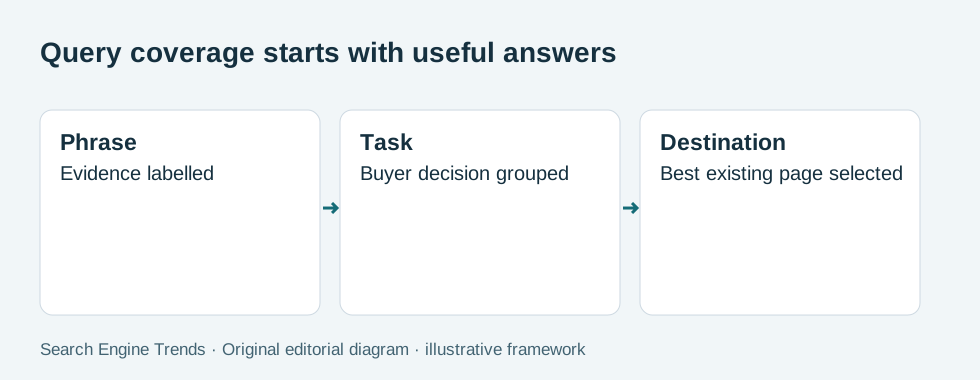
Two searches may use different words while asking the same question. “Small desk shipping cost” and “delivery price for compact desk” can belong to one task if the store’s delivery rules and product destination are the same. A request for assembly instructions is a different task even when it contains the same product name.
Build clusters using the answer and destination, not shared vocabulary alone. Product selection, compatibility, delivery eligibility, maintenance and refund handling often require different kinds of information. Decide whether the best response is a product page, category, guide or support document.
For each proposed page, write a one-sentence completion test: after reading it, what can the visitor decide or do? “Choose a desk that fits a 90-centimetre recess” is inspectable. “Learn about desks” is too vague to establish whether another article adds anything.
Separate language needs from market differences
An English page can serve several markets when its answer is genuinely shared. Separate versions become useful when currency, available products, measurements, delivery rules or support arrangements materially change the decision. Do not create a US, Canadian and UK page solely to swap country names.
Google’s multilingual and multiregional guidance explains the distinction between languages and regions. Use a market register to document the business’s real coverage. An article mentioning Switzerland does not establish a Swiss office or prove that a retailer ships there.
For genuine alternate versions, follow Google’s hreflang documentation. The corresponding pages must answer the same underlying topic in their intended language or market. An English buying guide and an unrelated French homepage are not a useful editorial pair.
Localise the evidence as well as the phrasing. A British page discussing dimensions can use centimetres where appropriate, while an American version may need inches with a checked conversion. Product availability and delivery statements require verification independently of translation quality.
Use a hypothetical expansion funnel
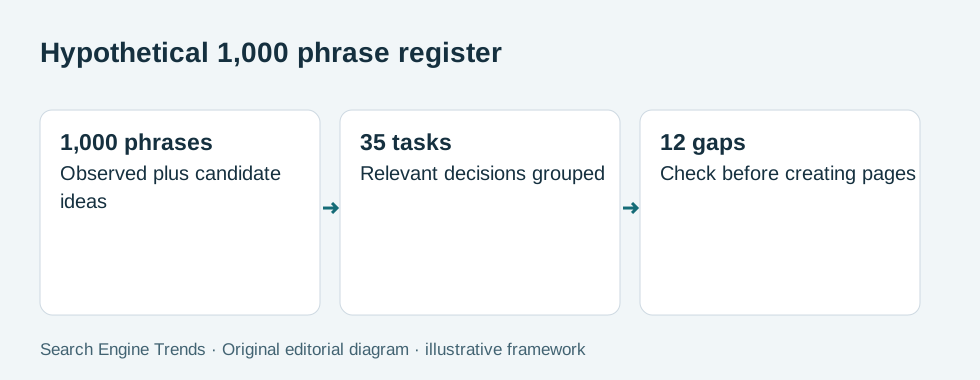
Suppose an imaginary retailer begins with 100 observed query phrases. An initial review groups them into 20 buyer tasks. Further research generates 900 candidate phrases, bringing the working register to 1,000. That register is a research asset, not a ranking claim.
| Hypothetical review stage | Phrase count | Editorial meaning |
|---|---|---|
| Existing observed phrases | 100 | Starting evidence for the exercise |
| Additional research candidates | 900 | Ideas requiring relevance checks |
| Relevant candidates retained | 420 | Fit products, markets and supported questions |
| Distinct tasks across retained candidates | 35 | Potential answer groups, not automatic new pages |
| Tasks adequately covered already | 23 | Improve or maintain their existing destinations |
| Uncovered tasks | 12 | Investigate whether new content is justified |
The exercise leaves twelve gaps to inspect rather than nine hundred articles to commission. One gap might require a compatibility table within a product page. Another could merit an original guide that compares supported applications. A third may remain unpublished because the business cannot substantiate the answer.
If the team can thoroughly research four gaps in its next cycle, schedule those four. A larger publishing quota does not create product evidence or reviewer capacity. The remaining eight can stay in the backlog with a reason and next research step.
Measure coverage without rewarding page inflation
Maintain cohorts of pages changed in the same editorial cycle. Compare consistent periods, markets and search types, and annotate significant commercial events. A promotion can change demand while a page revision changes the answer; the two effects should not automatically be attributed to SEO.
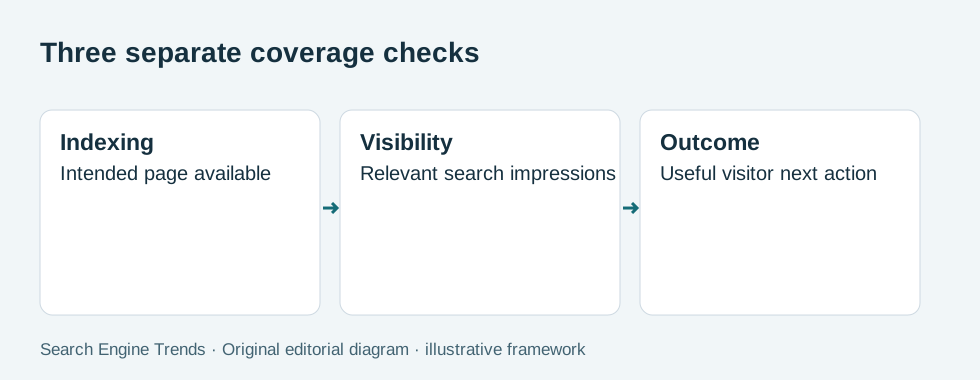
Use three different questions. Are the intended pages accessible and indexed? Are relevant queries receiving impressions? Are visitors reaching the useful next step? Each requires different evidence. A higher impression count does not prove profitable orders, and a submitted URL does not prove indexing.
For a hypothetical twelve-page cohort, ten indexed pages would represent ten divided by twelve, or approximately 83%. That fraction describes this defined cohort only. Inspect the two exceptions separately: a duplicate canonical and an unavailable page have different remedies. Do not turn the percentage into a universal site-quality score.
Compare new-query relevance manually. If impressions grow for unrelated meanings of a product term, raw coverage can rise while commercial usefulness falls. Conversely, a small increase for a difficult compatibility question may serve a valuable audience even before it generates substantial traffic.
Query expansion checklist
- Preserve the evidence source for every phrase.
- Group by the question and useful destination.
- Verify the market’s actual commercial conditions.
- Improve existing answers before commissioning duplicates.
- Publish only substantiated gaps with an identified reader outcome.
- Track stable page cohorts and relevant queries.
- Keep search visibility separate from conversion and retained revenue.
Google’s spam policies are relevant when expansion turns into low-value scaled pages or doorway patterns. A city list is not a substitute for evidence of a different local service or buying problem.
FAQ
Should every long-tail phrase have its own article?
No. Several phrases can lead to one comprehensive answer. Create another page when the visitor needs a meaningfully different destination or decision.
Is 1,000 queries a useful target?
It can be a research milestone if the register stays relevant and evidence-labelled. It becomes misleading when presented as guaranteed rankings or used to justify unnecessary pages.
What should happen to unsupported market queries?
Keep them outside the publication queue until the business can substantiate the product, delivery or service information. A speculative market page can create promises the purchase journey cannot fulfil.

SEO Foundations
Explore this related DIY Marketing Guide guide to work further on the method. DIY is part of our business group; contents, language and price are shown on its store.
See the English guide