
A DIY SEO calendar should map customer questions to the page that can answer them, then schedule evidence, writing and review. Improve existing product and category pages where appropriate, reserve guides for explanation, and use observed search data without inventing demand.

In this article
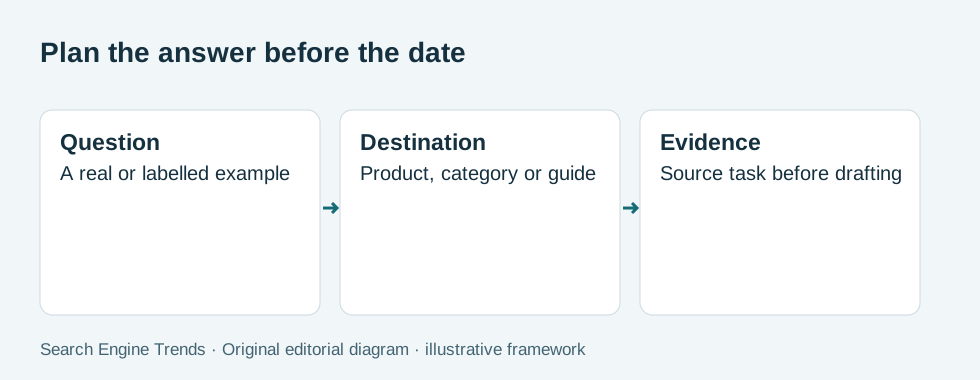
A DIY SEO calendar should begin with customer questions and existing pages. Ten questions do not automatically require ten new articles. A verified product measurement, a clearer category comparison or a working help link may solve the problem more directly than another blog post.
The calendar follows missing answers in your own catalog. A season or selling area becomes a priority factor only when your observations support it. The ten fictional questions below teach task classification; they are not evidence of demand in a particular city.
Map the question to the right page job
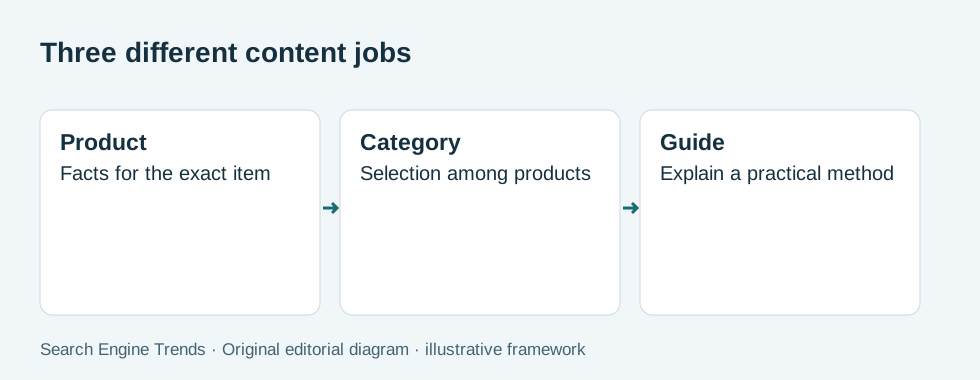
For a hypothetical workshop-supply store, distinguish product facts, product selection and operating methods. A question about pack quantity belongs on the relevant product page. A question about choosing among storage sizes may belong on the category. A question about measuring workshop space deserves an explanatory guide.
Record where each answer currently lives and whether it is complete. An existing guide may have the right purpose but an outdated diagram. A product page may need one missing field rather than a rewrite. Planning from the gap keeps the calendar tied to useful work.
Use actual customer questions where available and label illustrative ones. The ten questions in this article are invented examples; they are not measured search demand or claims about the store’s support history.
Require evidence before reserving a writing slot
An accurate answer may need a supplier sheet, an approved measurement, an original photograph or a tested destination link. Schedule obtaining that evidence before the draft. A publication date without a source task encourages vague wording when the writer reaches a missing fact.
Google’s Search Console performance documentation explains search performance reporting. Use the queries and pages you actually observe as one input. A missing query in a small report is not proof that nobody asks the question, and an impression count is not the same as purchase intent.
Use ten hypothetical questions as a worksheet
| Illustrative question | Useful destination | Evidence needed |
|---|---|---|
| What are the usable dimensions? | Product page | Verified measurement |
| How many items are in a pack? | Product page | Actual pack specification |
| What material is used? | Product page | Supplier document |
| Which accessory fits? | Product page | Confirmed compatibility |
| Which type should I choose? | Category | Selection criteria |
| How do sizes differ? | Category | Comparable dimensions |
| How do I measure my space? | Guide | Original measurement diagram |
| How should I prepare installation? | Guide | Applicable steps and limits |
| How should I maintain the item? | Guide | Relevant instructions |
| Where can I download the file? | Help page | Real link checked |
Some rows can share evidence without sharing the same page. The dimension record can support both a product specification and a size comparison, while the guide explains how a customer applies that measurement. Retain the source relationship so a supplier change reaches every affected answer.
Prioritise by usefulness and readiness
Give each row a clear commercial consequence. Missing compatibility can block a decision; an unclear help link can prevent use after purchase. Compare that consequence with the effort and evidence available. A low-effort correction that resolves a buying-critical gap can deserve priority over an ambitious guide with no approved instructions.
Keep readiness separate from value. A valuable article may be blocked until a product expert confirms the method. Do not lower its accuracy standard to fit the week. Move a ready task forward and give the missing evidence a named owner.
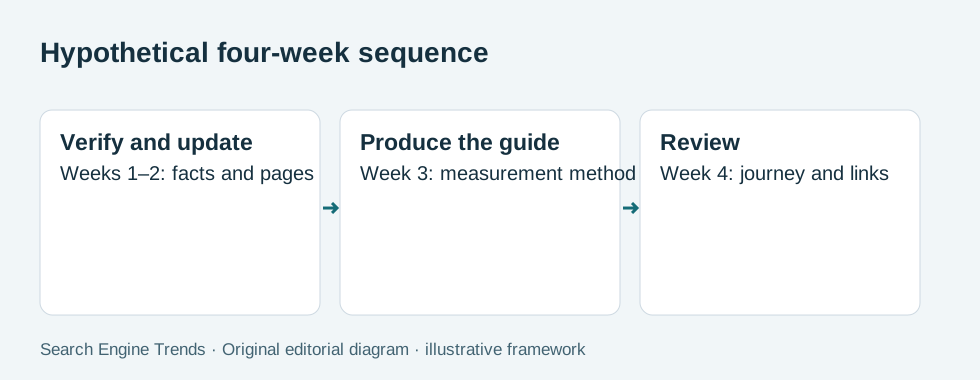
For an illustrative four-week schedule, use week one to verify dimensions and pack contents, week two to update products and the size comparison, week three to produce the measurement guide, and week four to check links and review the published journey. The sequence is hypothetical; its purpose is to show dependencies, not a universal monthly cadence.
Review the result after a coherent observation period
Check that the intended changes reached the rendered pages: tables, images, links and language versions. Then assess search impressions, relevant visits and buying progression under the store’s actual measurement setup. An editorial task can be completed before enough traffic exists to evaluate its commercial effect.
Annotate major changes such as stock availability, prices and promotions. If orders increase during a discount campaign, do not attribute the entire increase to a rewritten guide. Use observed patterns to select the next review, and preserve uncertainty where the dataset cannot support a confident conclusion.
Calendar checklist
- Record the actual question and suitable page destination.
- Review the existing answer before planning a new URL.
- Identify the evidence and the person who can verify it.
- Schedule research before writing and review before release.
- Link guides to the appropriate product-selection step.
- Distinguish publication completion from measured outcomes.
A small DIY workbook can contain the question map, source register and review columns. It should help the merchant decide what to fix next. Avoid positioning it as a guarantee of traffic or using unverified search-volume numbers to make the plan appear more precise.
Keep a small maintenance queue beside the calendar
After publishing the measurement guide, retain a list of the product records it references. If a supplier changes the usable dimensions, the guide and category comparison may need review as well as the product page. Assign that update to the evidence owner instead of waiting for the next planned article.
Use a maintenance status distinct from new content. A working file-download link can break, a product can become unavailable and a screenshot can show an old interface. None of those changes necessarily warrants another URL, but each can make an existing answer less useful.
For the fictional workshop store, a weekly review could inspect unresolved compatibility fields, unavailable linked products and blocked source tasks. That review is an illustrative operating cadence, not a search engine requirement. Its value is that a publication schedule stays connected to the actual buying journey, rather than declaring success simply because all four weekly deadlines were met.
FAQ
Should a DIY calendar publish every week?
Choose a pace the evidence and review process can support. A useful product correction or guide update can be a valid calendar task without creating another article.
Can one question map to several pages?
Related questions can support several page jobs, but avoid duplicating the same answer unnecessarily. Define the product, category or guide purpose and link them where helpful.
How can a new store prioritise without much search data?
Use buying-critical information gaps, real questions and evidence readiness. State the limited search history rather than inventing a volume forecast.

SEO Foundations
Explore this related DIY Marketing Guide guide to work further on the method. DIY is part of our business group; contents, language and price are shown on its store.
See the English guide