
Ecommerce filters should help customers select products without creating a search page for every combination. For a store serving London, identify durable selections with genuine demand, separate duplicate handling from indexing and crawling, and check representative URLs before extending the rules across the catalogue.
In this article
- A useful filter does not always need its own search page
- Map the filters and the URLs they produce
- Compare three selections with different purposes
- Distinguish canonical, noindex and crawl controls
- Handle empty results and unstable selections explicitly
- Keep internal links consistent
- Measure the URL space alongside its usefulness
- Start with a controlled change
A useful filter does not always need its own search page
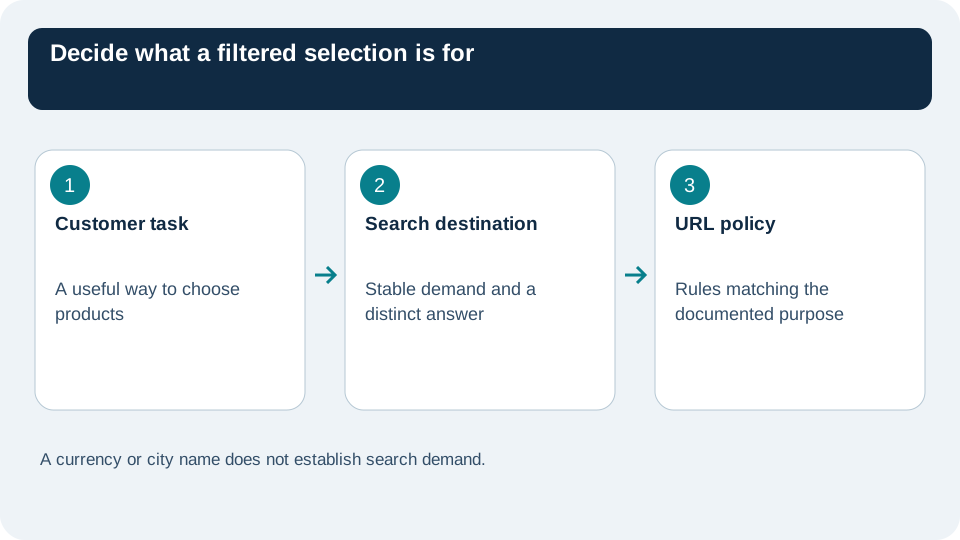
A shoe size filter can be essential for shoppers even when it does not deserve a separate destination in search. The first decision is therefore about the customer task. Does the selection help someone choose, and does it offer a stable answer worth finding independently? These questions should be answered before adding technical instructions to thousands of URLs.
Consider a fictional footwear catalogue serving London. No shop, local search demand or customer behaviour has been measured for this example. The store might charge in GBP, but a currency label alone does not make a filtered page useful. The catalogue, its stock and the needs you can document determine the selection.
Colour, size, use, price and sort order create many possible states. Some genuinely change the product choice; others simply reorder the same items. Keep the distinction visible in a worksheet. It will help a developer implement your decisions without assuming that every available control should produce an indexable page.
Map the filters and the URLs they produce
List each filter, its possible values and the resulting parameter or path. Record whether customers can select multiple values, change their order or combine them with sorting. Two routes can lead to the same set of products while generating different addresses. Include these equivalent routes in the inventory.
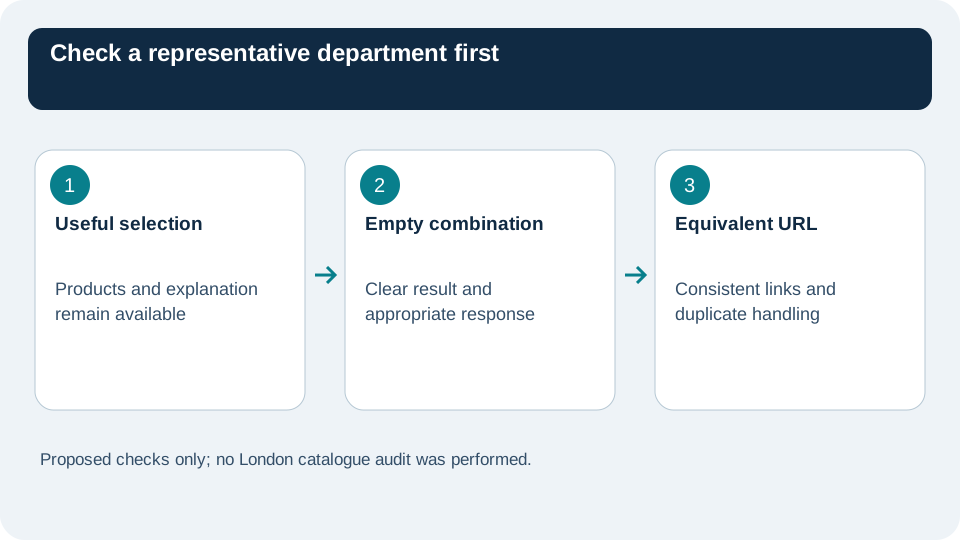
Begin with one department rather than the entire shop. Save examples of an unfiltered category, a useful selection, a narrow combination, a sort-only state and an empty result. Open them on the devices customers use. Confirm that removing a filter restores a understandable selection and that product links remain accessible.
Google's faceted navigation guidance explains the resource costs of large filter URL spaces. Use it to review the implementation, while keeping the commercial decision separate: a crawler rule cannot tell you whether the selected shoes answer a real customer need.
Compare three selections with different purposes
Imagine a fictional category containing sixty references. A walking-use selection contains twenty products with documented criteria. Blue shoes in size 42 contain three products whose stock changes. Sorting by price changes the order without changing the set. These invented quantities illustrate the decision; they do not describe demand in London.
| Selection | Difference to examine | Proposed direction |
|---|---|---|
| Walking use | Stable product family and useful criteria | Consider a durable search destination |
| Blue and size 42 | Narrow, variable stock | Prioritise shopper navigation |
| Price ascending | Same products in another order | Review duplicate handling |
| No matching products | No answer to the selection | Return a clear empty-result experience |
A durable page remains a proposal until demand, stock and content have been checked. Manufacturer wording is a product description, not evidence that shoppers search for a particular category. The page should add a meaningful selection and explanation rather than merely place more keywords above a product grid.
Distinguish canonical, noindex and crawl controls
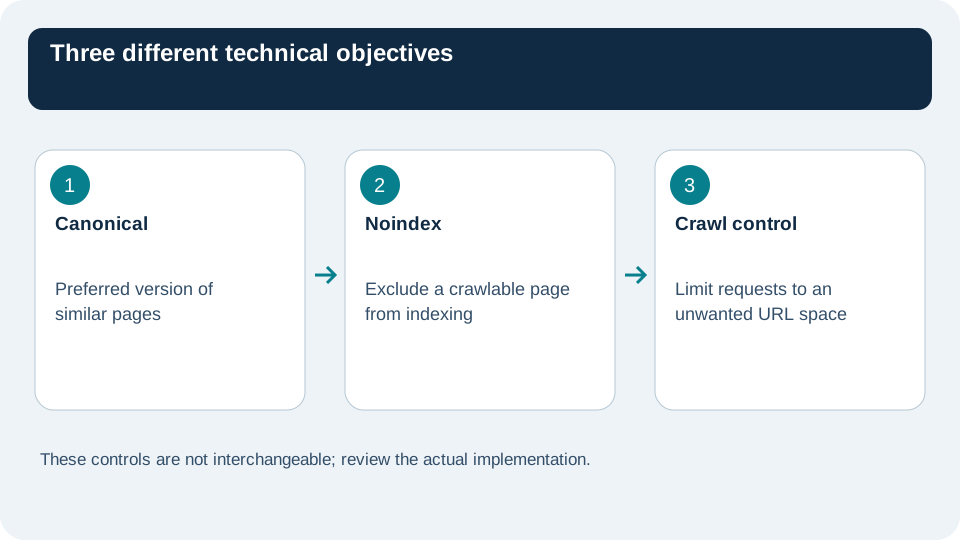
Canonicalisation signals a preferred version among duplicate or very similar pages. It does not prevent a crawler from requesting the alternatives. A noindex instruction asks for a page to be excluded from search indexing, and the crawler must be able to see that instruction. A robots.txt disallow rule concerns crawling rather than guaranteed removal from the index.
Read Google's noindex documentation and its canonicalisation guidance for the implementation details. Write the intended outcome beside each proposed rule. Do not combine several directives simply because each sounds like an SEO improvement.
Ask the person implementing the change to explain how the selected page can still be discovered and inspected. A rule that prevents a crawler from reading a page can also prevent it from seeing an instruction on that page. Review existing indexed URLs separately from new navigation states so the transition is deliberate.
Handle empty results and unstable selections explicitly
An empty selection should explain that no products match and let the shopper remove a constraint. It should not continue claiming that the promised products exist. Google's faceted navigation guidance recommends an HTTP 404 for combinations that produce no results, including nonsensical combinations. Check how your actual application can deliver the appropriate response without trapping the user.
A price filter may change substantially when promotions start or end. Review its stability before treating it like a permanent category. A page with ten products today and none tomorrow needs a different plan from a durable product family. Record the reasoning so a later administrator does not enable every combination after seeing impressions for one selection.
Where a selection is useful but temporarily unavailable, decide how customers should understand the situation. Do not silently replace its meaning with a broader category. The technical response and visible message should reflect the real state and the rules you have reviewed for that kind of page.
Keep internal links consistent
Use a consistent parameter order and avoid unnecessary values when linking to the same selection. Inspect pagination, breadcrumbs and JavaScript-generated controls. A correct canonical on the first view does not establish that later pages or alternative paths behave consistently.
Do not remove all filtering to solve a crawling problem. Customers still need to select the right size, use and budget. Separate destinations intentionally offered to search from temporary navigation states, then verify that important products remain discoverable through the category and other relevant links.
Measure the URL space alongside its usefulness
Four filters with five values each generate 625 combinations when one value is chosen from every filter. This arithmetic example explains scale, not search demand. Real systems may also create partial selections, multiple values and sort states, increasing the number of URLs beyond that simplified calculation.
Track the pages you intend to offer to search, the empty combinations encountered and the useful selections receiving relevant impressions. Logs and Search Console reveal different parts of the situation when access is available. A reduction in requests is not enough if worthwhile products become harder to find.
Start with a controlled change
Choose ten representative URLs from the department, document the expected behaviour and review the proposed rules. Apply changes in an appropriate environment, then inspect the rendered page, response and customer navigation. This guide proposes that check; it does not report a test completed on a real London shop.
Keep the previous configuration and a record of the change so an unintended effect can be investigated. Extend the approach only after the first department remains usable and its important destinations behave as intended. The result should be a catalogue with helpful filters and a deliberate set of search pages, each supported by a reason you can explain.

SEO for Your Online Store
Explore this related DIY Marketing Guide guide to work further on the method. DIY is part of our business group; contents, language and price are shown on its store.
See the English guide