
Organise a Miami store’s bilingual pages around complete buying journeys in English and Spanish. Give each language a stable URL, link equivalent pages, and manage country, currency and delivery eligibility separately from translation.
In this article
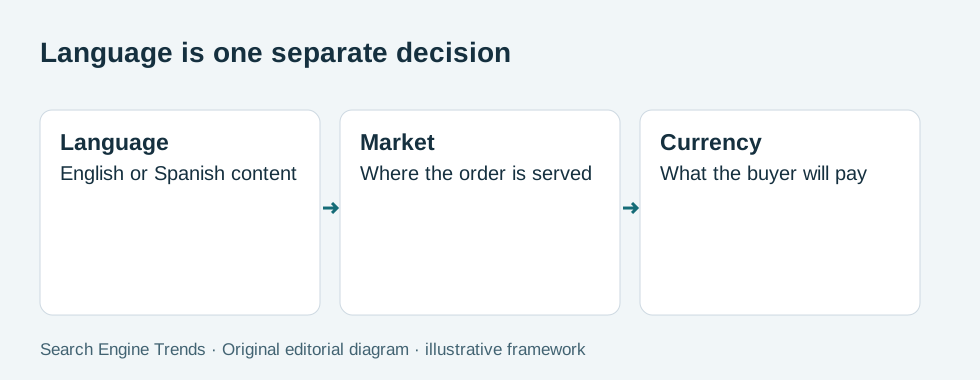
Miami bilingual SEO starts by separating language from destination. A Spanish-speaking customer in Miami can still be buying in US dollars for a Florida address. An English-speaking customer may be ordering abroad. Translate the buying journey, then configure the market and delivery options according to the order rather than inferring them from language.
Choose the pages that deserve two complete versions
A hypothetical Miami retailer might begin with a product category, its delivery guide and its returns explanation. Translate the core product facts, variant labels and support route alongside those pages. Translating the navigation alone leaves shoppers with an English-only decision at the point where accuracy matters most.
Inventory the existing pages and identify equivalent intent. An English page explaining local collection should pair with the Spanish explanation of that same service. A Spanish campaign aimed at a different product range may need its own content relationship rather than being labelled as an exact translation.
Google’s multilingual site guidance supports distinct language URLs and a clear way for users to choose. Maintain a visible language switcher and preserve the current product or article when an equivalent version exists.
Review language, commerce and location independently
Create a page register with language, destination market, currency, service coverage and translation status in separate columns. This prevents a Spanish page from accidentally adopting a shipping policy intended for another country. Use real operational details; the city context does not justify inventing a Miami showroom or address.
Equivalent intent
Do both pages help the customer make the same decision? Compare the product scope, buying instructions and support route. Record intentional differences rather than silently linking a general guide to a promotional landing page.
Check against a reviewed English-to-Spanish page mapping. If the translated page describes a different offer or omits essential instructions, review the affected case before continuing. Equivalent language URLs need equivalent purpose even when the phrasing and cultural examples differ.
Market separation
Which destination and currency does this page actually serve? Keep language, checkout market and delivery eligibility in different configuration fields. Test a Miami shipping address in both language journeys.
Check against two checkout previews with the same stated destination and currency. If changing the language changes a delivery promise without explanation, review the affected case before continuing. A language choice should not silently convert an ordinary US order into an international transaction.
Translation maintenance
Who updates the Spanish version when the source changes? Assign an owner for changed product facts, policies and interface labels. Mark incomplete updates clearly in the page register and withhold unsupported promises.
Check against a change log naming the reviewed translation revision. If the English product specification changes but the Spanish claim remains old, review the affected case before continuing. Publishing is only the first step; a bilingual store also needs reliable maintenance after launch.
Model a bilingual launch without doubling everything
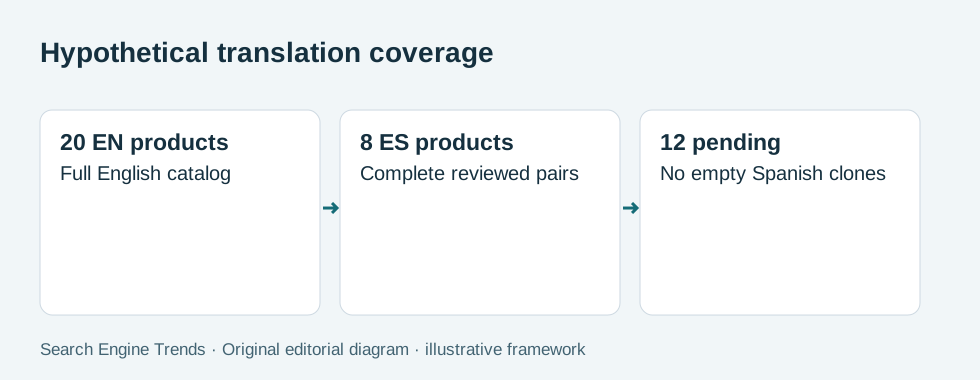
Consider an explicitly hypothetical launch with twenty English product pages. Eight have completed Spanish translations; twelve remain English-only. The completed pairs can be linked as equivalents. The untranslated pages should not receive empty Spanish URLs that display the same English body.
| Page group | English pages | Complete Spanish pages | Launch action |
|---|---|---|---|
| Core products | 20 | 8 | Pair the eight reviewed versions |
| Delivery explanation | 1 | 1 | Confirm identical service boundaries |
| Returns explanation | 1 | 1 | Review policy wording separately |
Tell users when a product detail is available only in English, and offer the actual support language your team can provide. A language selector that returns shoppers to the homepage hides the missing equivalent and discards their progress. Where a translation is unavailable, retain a useful destination instead of pretending the journey is complete.
Add technical signals after editorial review
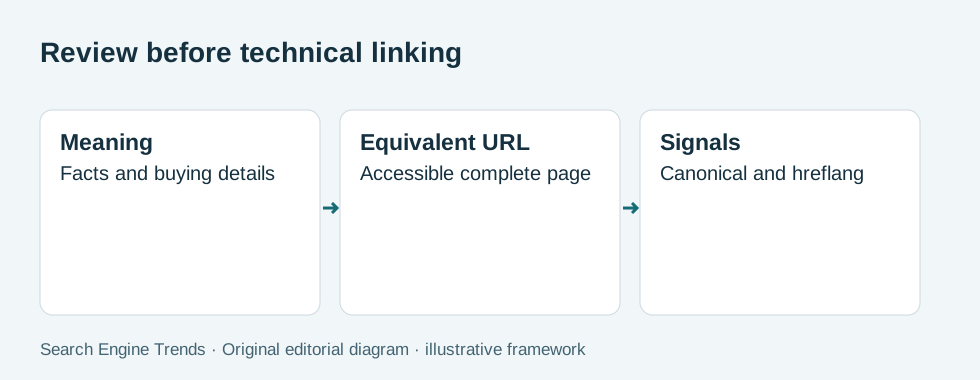
Google’s hreflang documentation requires reciprocal references among linked alternatives. List only existing, appropriate URLs. Use language codes, optionally with relevant country targeting, rather than using a country code as though it named a language.
Review each language’s canonical separately. A genuine translated page generally needs a canonical that represents its own URL; pointing every version to the English page can send contradictory signals. Have the technical team check the rendered head, status codes and internal links rather than relying on a spreadsheet containing the intended configuration.
Measure English and Spanish landing performance separately. Compare product discovery, checkout progression and support questions, using similar page types and time periods. A low-volume translation needs time and qualitative review; it cannot support a confident conversion claim after a handful of visits.
Inspect a language switch at the point of choice
Open a product in English, select a color and then switch to Spanish. Check whether the equivalent item appears, whether the option remains understandable and whether delivery eligibility stays appropriate to the same Miami address. If the store cannot preserve the selected variant, explain the selection state rather than showing an unrelated default without context.
Review one product whose Spanish translation is still pending. The selector should not create the impression that a complete Spanish version exists. A language-labelled link to the available content can be an interim choice; an empty Spanish page with an English body is not a finished translation.
The page register should also identify language-specific support limits. If the team can answer product questions in Spanish but provides technical installation help only in English, describe that accurately where it matters. Do not infer service capability from a translated landing page. This review turns bilingual SEO into a maintained customer journey and prevents the technical language map from outrunning the content and support actually available.
Checklist before opening the language switcher
- Confirm that translated pages answer the same buying questions.
- Review variant names, measurements and instructions with a fluent reader.
- Keep US destination and currency settings independent from language.
- Pair only complete, accessible equivalents.
- Check reciprocal hreflang and appropriate canonicals.
- Test a direct product link and a full mobile checkout journey.
- Publish truthful support and service-location information.
Start with a smaller set of complete journeys. Expand when translation maintenance has an owner and product changes reach both versions. More language URLs do not compensate for contradictory sizing, incomplete policies or a checkout that unexpectedly changes the market.
FAQ
Does Spanish content need a separate domain?
Separate domains are one architecture option, not a requirement. Stable language subdirectories can work when the pages, links and maintenance process are coherent.
Should Spanish automatically mean another currency?
No. Language preference and transaction market are different choices. Show currency explicitly and use the destination settings relevant to the order.
Can a Miami page claim a local store for SEO?
Only describe locations and services that actually exist. An educational page for Miami merchants can discuss local buying problems without claiming the publisher has an office there.