
Make product pages useful for specific holiday buying decisions: fit, compatibility, included components and delivery eligibility. Publish facts supported by current evidence and keep visible information, images and structured data consistent. Google’s AI eligibility still depends on ordinary Search requirements and inclusion; it does not guarantee placement.
In this article
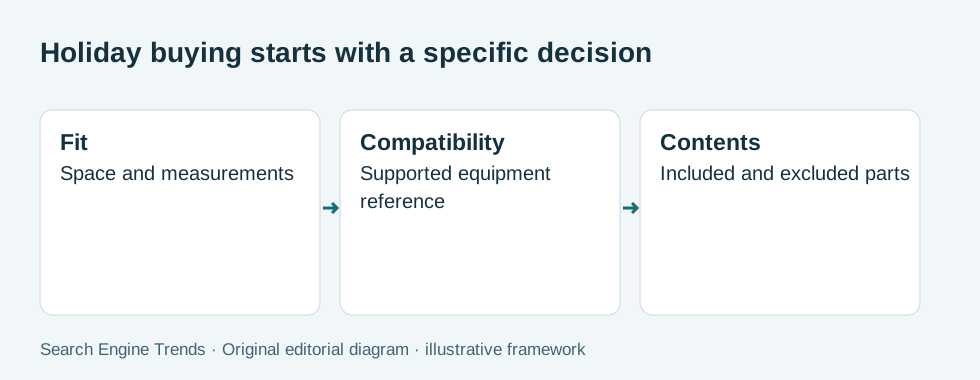
Ecommerce GEO work should help a shopper make a reliable product decision. For holiday purchases, that usually means answering whether an item fits, works with the recipient’s equipment, includes the required components and can reach the destination under the current delivery rules. Clear evidence matters more than repeating “perfect gift” across a catalog.
Google’s 2026 generative AI optimisation guide connects AI visibility to established Search practices. Pages must be indexed, eligible for a snippet and included in Search’s generative AI features. Meeting those conditions does not guarantee that a page will appear.
Start with a gift decision the product can actually resolve
Choose a buying question and identify which product facts determine the answer. A desk organiser gift might depend on available space, compartment dimensions and whether assembly is required. A lamp may require power information and compatibility. A refill pack might require an exact recipient model reference.
The adjective “versatile” does not answer these questions. Replace it with supported details: the footprint in stated units, a list of included parts, a clear compatibility reference and any known limitations. Keep a supplier statement distinguishable from an internal measurement or documented check.
If the shopper does not know the recipient’s model, help them find the reference or choose a product that does not depend on it. Do not suggest that uncertainty can be solved by reassuring wording. A useful page can honestly explain why a purchase should wait for one missing fact.
Connect the task to the Q4 planning hub. This helps an editorial team prioritise facts that affect seasonal decisions without turning every product description into a campaign page.
Use an original hypothetical gift comparison
Imagine a retailer with three fictional products. The attributes below are invented for this editorial exercise and must not be reused as claims for actual merchandise.
| Hypothetical gift | Known facts in the exercise | Buyer question | Reason to pause |
|---|---|---|---|
| Compact tray | 24 × 16 cm footprint; one tray included | Does the recipient have that clear desk area? | Available space is unknown |
| Clip-on light | Clamp opening up to 35 mm; cable included; adapter excluded | Is the desk edge suitable and the required adapter available? | Desk thickness or power requirements not confirmed |
| Planner refill | Fits fictional model P-4 only; twelve sheets included | Does the recipient own model P-4? | Recipient’s planner reference unknown |
The tray page needs dimensions and a scale view. The light page needs the supported clamping conditions, power specifications and contents list. The refill page needs an exact compatibility statement and a way to locate the recipient’s model reference. Writing three versions of “an ideal present for anyone” would obscure the real differences.
A comparison guide can bring these decisions together and link to the corresponding product pages. Keep product facts on the actual destinations as well. A shopper arriving directly from Search should not need to discover a separate guide to learn that an adapter is excluded.
Do not rank the products from best to worst without defining the criterion. “Best for a desk with limited free surface area” is a contextual selection that needs supporting dimensions. “Best holiday gift” is too broad to verify from this table alone.
Build a claim-to-source register before drafting
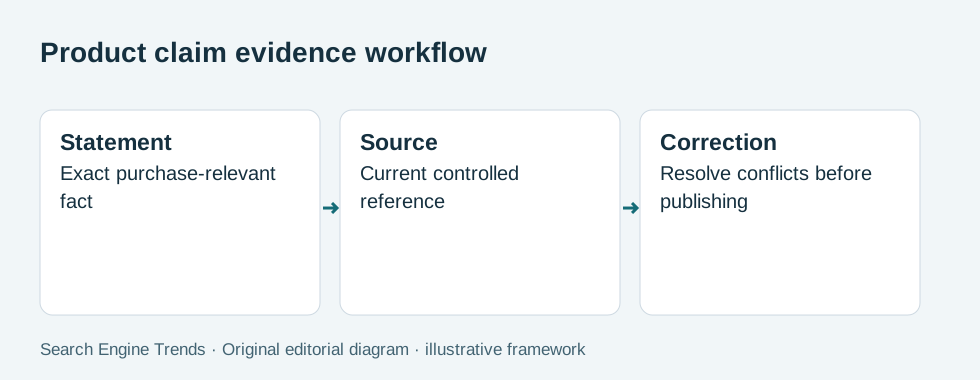
Create a compact evidence register for the statements that can affect a purchase. A suggested CSV structure is:
product_ref,claim,source_ref,source_date,review_status,page_location
fictional-tray,24 x 16 cm footprint,exercise-spec-A,illustrative,needs real evidence,dimensions
fictional-light,adapter excluded,exercise-spec-B,illustrative,needs real evidence,contents
fictional-refill,fits model P-4 only,exercise-spec-C,illustrative,needs real evidence,compatibility
These are original worksheet fields and fictional records, not a supplier feed or a completed audit. Replace the exercise entries with actual controlled source references before publication. Avoid putting private supplier contracts or customer information into a publicly downloadable file.
Check conflicts explicitly. If a supplier specification gives one footprint while a current image annotation gives another, do not ask an AI tool to choose the more plausible number. Resolve the discrepancy with the product owner and revise the affected page sections together.
Treat delivery as an operational claim. “Arrives before the holiday” needs destination, dispatch conditions and reliable evidence that supports the promise. If the business can only state an estimated delivery range, label it accordingly. A product fact register should not turn an estimate into a guarantee.
A source date is useful when the item changes revision. The old compatibility evidence may remain correct for old stock while becoming wrong for a new component. Tie the statement to the product version being sold rather than assuming that one supplier file covers all future units.
Keep visible facts, structured data and images coherent
Use Google’s product structured-data documentation to select the relevant product implementation. A buyable product page and an editorial comparison have different contexts. Structured data can support eligibility for product search experiences; it should describe the actual product and offer information rather than introduce invisible claims.
Compare the rendered price, selected variant, availability and included components with the data the page exposes. A page showing an out-of-stock variant while its markup describes a different available variant creates a consistency problem. The remedy starts with product and template logic, not extra SEO adjectives.
Images should answer something the text alone leaves hard to judge. Show the footprint with clearly stated dimensions, an included-parts view and the relevant fitting detail when appropriate. If a photograph includes a decorative accessory, explain that it is not included where a shopper could reasonably misunderstand it.
Google’s image guidance recommends relevant image placement and useful descriptive context. Write alt text for the actual image and its purpose. “Top GEO gift holiday buy now” supplies less information than “clip opening shown beside a millimetre scale”.
Answer genuine support questions when they are relevant to purchase. A useful FAQ can explain where to find a model reference or which components are excluded. Do not promise a commercial FAQ rich result or add unsupported answers merely to populate a markup field.
Evaluate the purchase decision and the evidence coverage
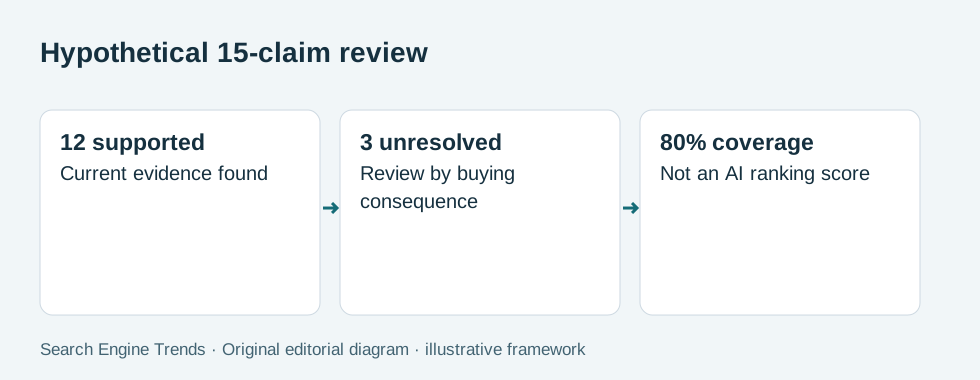
For a hypothetical audit of fifteen important product claims, suppose twelve have current supporting evidence and three remain unresolved. Twelve divided by fifteen is 80% evidence coverage for that defined claim list. It is not a Google score, a ranking factor or proof of AI readiness.
Classify the three gaps by consequence. A missing decorative colour description may need a supplier clarification. Unverified power compatibility or an unsupported delivery guarantee can affect the suitability of the purchase and deserves immediate attention. A single percentage cannot express that difference.
Use the business tools to assess margin separately from page visibility, and the resource library to organise working documents. A product can be accurately described and still have an unattractive contribution model; those are distinct decisions requiring different inputs.
Product-fact review checklist
- Identify the specific buyer decision.
- Verify dimensions, compatibility and included components.
- Resolve contradictory source information before drafting.
- Check stock and delivery wording for the destination.
- Make images useful for scale, contents or fit.
- Align visible product facts and structured data.
- Inspect indexing, snippet eligibility and AI inclusion separately.
- Measure visibility without promising placement or inferred sales.
Google’s guide explains that no special AI markup or LLMS.txt file is needed for its generative Search features. Use the team’s effort to fix unresolved buying facts and the actual page experience before pursuing unsupported formatting shortcuts.
FAQ
Does product schema guarantee an AI citation?
No. Appropriate structured data supports relevant Search eligibility, while AI appearance remains dependent on other requirements and Google’s systems.
Should every product page include a holiday FAQ?
Only when real buying questions justify it. A compatibility answer is useful; a repeated generic holiday paragraph may add little to the purchase decision.
What is the best first GEO improvement for a small catalog?
Find an important buyer uncertainty that the business can substantiate and publish the answer clearly. Pair that editorial improvement with checks that the intended page is accessible, indexed and eligible under the current settings.
GEO: Understand and Act
Explore this related DIY Marketing Guide guide to work further on the method. DIY is part of our business group; contents, language and price are shown on its store.
See the English guide