
Use stable French and English URLs for genuinely translated Canadian pages. Maintain complete equivalent pairs, make language choice visible, and check reciprocal hreflang plus appropriate self-referencing canonicals. Country targeting should reflect the page’s market, not the city name alone.
In this article
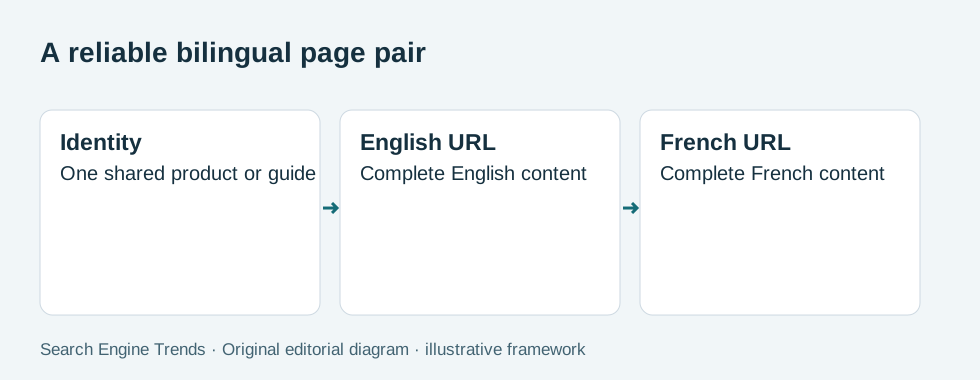
Toronto French English SEO URLs should identify complete language versions without creating unnecessary regional clones. For a Canadian store, a stable French directory and a stable English directory can support a coherent bilingual catalog. Keep the same product identity across languages while allowing readable, language-specific slugs.
Choose an architecture the team can maintain
A hypothetical Toronto merchant might use /en-ca/products/tool-case and /fr-ca/produits/coffret-outils. These are illustrative paths, not existing store pages. The important relationship is the shared item and complete translated buying information, not an exact match between the two slugs.
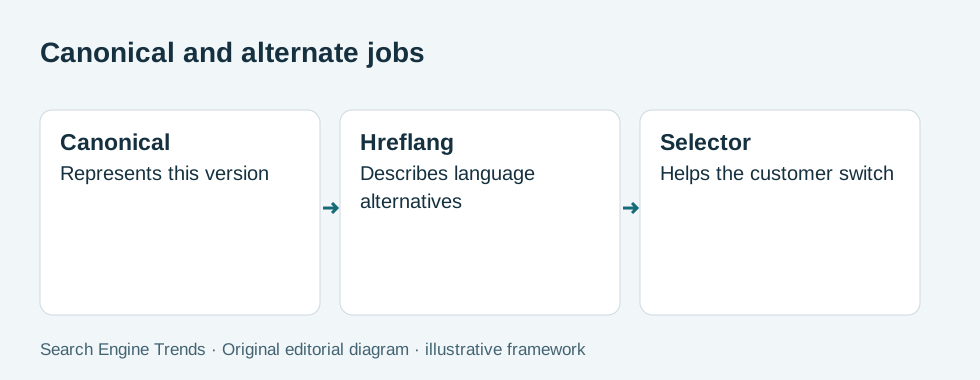
Google’s localized-page documentation describes reciprocal language annotations. Use en-CA and fr-CA where those pages genuinely target Canada; avoid inventing a city-level hreflang code.
Maintain a page-pair register
Record the canonical URL, language, translation status and equivalent page for each entry. Distinguish translated pages from English-only products so the technical implementation does not create empty French destinations.
Page identity
Which French page is equivalent to this English page? Match the actual product or guide purpose using a shared internal identity. Do not rely on similar slugs or identical publishing dates to infer equivalence.
Check against a bilingual mapping by stable page identity. If the alternate describes another product or offer, review the affected case before continuing. Technical links should connect equivalent content even when translators choose different wording and URL paths.
Canonical review
Which URL should represent this version within its language? Check the rendered canonical and any duplicate paths. Give genuine translations their own appropriate canonical rather than collapsing every language into the source version.
Check against a rendered-head review of both pages. If all French canonicals point to English source URLs, review the affected case before continuing. Canonical duplication decisions and alternate-language relationships are separate parts of the configuration.
Reciprocal alternates
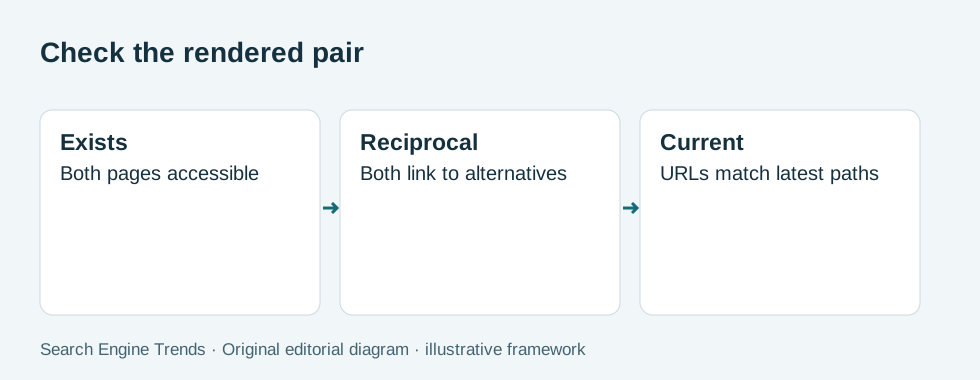
Do the actual pages link back to each other correctly? List the existing complete alternatives on both pages. Confirm valid language-country codes and fully qualified current URLs after redirects or slug changes.
Check against a bidirectional alternate check. If one alternate is missing, redirected incorrectly or nonexistent, review the affected case before continuing. A complete page register is useful only when its relationships reach the rendered pages.
Test a hypothetical Canadian page pair
The example below demonstrates relationships rather than a live configuration.
| Illustrative version | Canonical purpose | Alternate relationship |
|---|---|---|
| English Canadian product | Its English URL | French equivalent and itself |
| French Canadian product | Its French URL | English equivalent and itself |
| English-only product | Its English URL | No invented French equivalent |
The two complete translations should reference each other. A French product page should not point its canonical to an English version simply because English is the source language. Check for actual duplicate URLs within each language and handle those separately from the translation relationship.
Review the full bilingual journey
Test direct links, redirects and the language selector after a slug change. If an old English path redirects correctly but the French alternate still references it, update the page map. Redirects can help users reach a page, but maintaining current direct alternate URLs avoids a fragile configuration.
Review the actual HTML relationship
For the hypothetical tool case, open both language URLs and inspect the rendered canonical and alternate tags. Confirm that each complete version names the other with the current fully qualified address. A correct content-management field is not sufficient if the theme emits a different URL or an outdated redirect target.
Test a language switch from the product page itself. The French destination should be the same tool case, with the same relevant variants and buying information. Returning every switch to the homepage forces the customer to repeat product discovery and can conceal an incomplete translation.
Keep Canadian targeting separate from translation
The country component of a language tag describes the intended regional version. It does not automatically configure shipping, prices or tax treatment. Review those commerce settings independently, using the actual Canadian destination and transaction conditions supported by the store.
If the merchant also creates a genuinely different US English version, update the alternate set only after that page exists and has its own appropriate content. Do not create a US URL purely to increase the number of country tags. A Canadian English page and a generic English guide can also have different scopes; map equivalent purpose before treating them as alternatives.
Maintain the pair after a product change
When the supplier changes the tool-case dimensions, update the source record and assign the translated field for review. Check the specification table, image text and downloadable instructions in both languages. A canonical and hreflang configuration can remain technically correct while one language describes an old product. Keep the translation revision in the page register so the next content update can identify what has actually been reviewed rather than assuming all published pairs are current.
Review any automatically detected language preference as a suggestion rather than allowing it to erase the user’s chosen version. A French-speaking reader may intentionally open an English technical document, and a Canadian buyer may share an English product URL with a colleague. Keep a visible way to switch back and test direct links from an external source. The destination must remain understandable without requiring a previous homepage visit. This protects useful shared URLs and gives the technical team a concrete case for checking unexpected redirects.
URL review checklist
- Use stable language URLs with complete main content.
- Pair pages by product or guide identity.
- Confirm each page’s appropriate canonical.
- Include reciprocal language references and valid codes.
- Remove nonexistent alternates.
- Preserve equivalent destinations through the language selector.
FAQ
Must French and English slugs be identical?
No. Readable translated slugs can differ. Keep the page mapping explicit so technical relationships remain correct after editorial changes.
Does hreflang guarantee the preferred page will rank?
No. It communicates alternate versions. Page quality, indexing and search relevance still require their own review.
Should Toronto get separate pages from the rest of Canada?
Only when a distinct user task or real service difference justifies them. A duplicated national page with the city inserted is a weak editorial reason to create another URL.

Audit and Fix Your Website
Explore this related DIY Marketing Guide guide to work further on the method. DIY is part of our business group; contents, language and price are shown on its store.
See the English guide