
Connect language versions only when both pages genuinely answer the same question and can be maintained. For a site serving Zurich, distinguish translations from regional variants, verify the final URLs and return relationships, and leave missing languages unannounced until their content is complete and reviewed.
In this article
- Publish the languages that actually exist
- Separate translation from regional adaptation
- Maintain a register of equivalent pages
- Verify the final URLs before technical annotation
- Review canonical and language signals for different purposes
- Cross-review the facts that affect the reader's decision
- Check the selector as a customer journey
- Review every shared change across the set
Publish the languages that actually exist
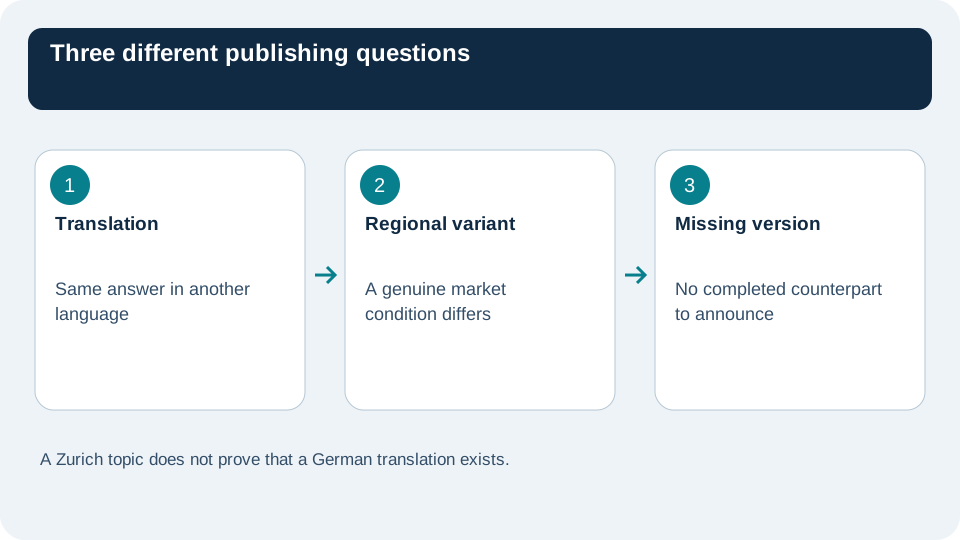
A Swiss topic does not require a website to pretend it has a German version. A French-English publication can explain a question concerning Zurich while offering only the languages it can produce and maintain. A missing translation should remain missing rather than become an empty URL or a link to a different subject.
This guide uses a fictional set of language pairs. No multilingual merchant has been audited, and no local demand or search performance is claimed. The examples demonstrate a publishing register and technical checks to carry out on your own pages.
Begin with the central answer each page provides. A counterpart should answer the same question or describe the same reference with coherent facts. Idiomatic writing may differ; dimensions, included contents and purchase conditions should not accidentally change because a translation reads more naturally.
Separate translation from regional adaptation
A translation primarily changes the language used to explain the answer. A regional variant may also change currency, available service or another genuine condition. Record those differences before deciding whether another URL is justified.
A city name alone does not create a distinct response. If two pages offer the same information with only Zurich and another city substituted, examine whether they provide separate value. A useful geographic example should be supported or clearly fictional, without implying an address or service that the publisher does not have.
Keep the reader's language and the page's market context in different fields. English does not automatically mean the United States, and German does not automatically mean Switzerland. The targeting chosen should reflect the actual content and offer rather than a template convention.
Maintain a register of equivalent pages
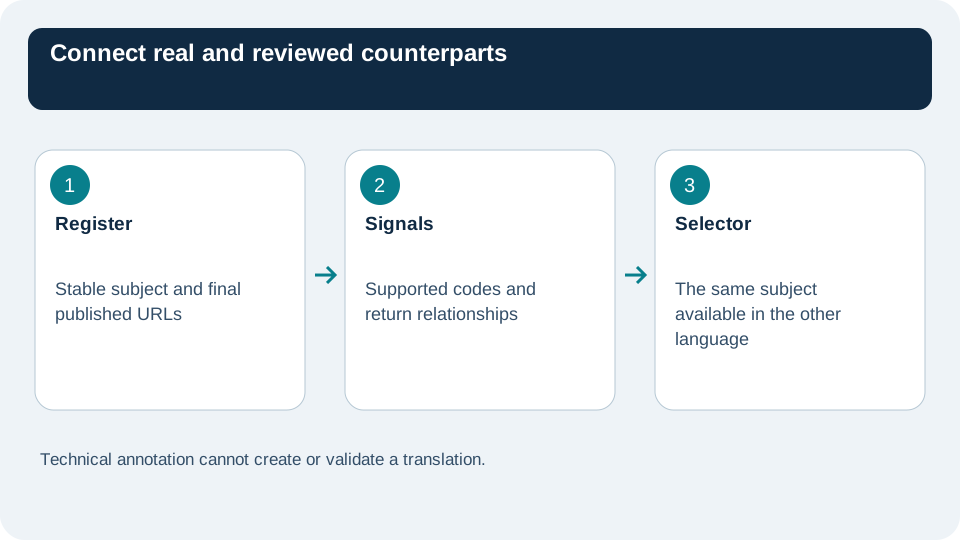
Assign a stable identifier to each subject and record the available languages, review date, final URL and publication state. This register helps distinguish a completed equivalent from a draft that merely has a filename. A language selector should use the published counterpart when it exists.
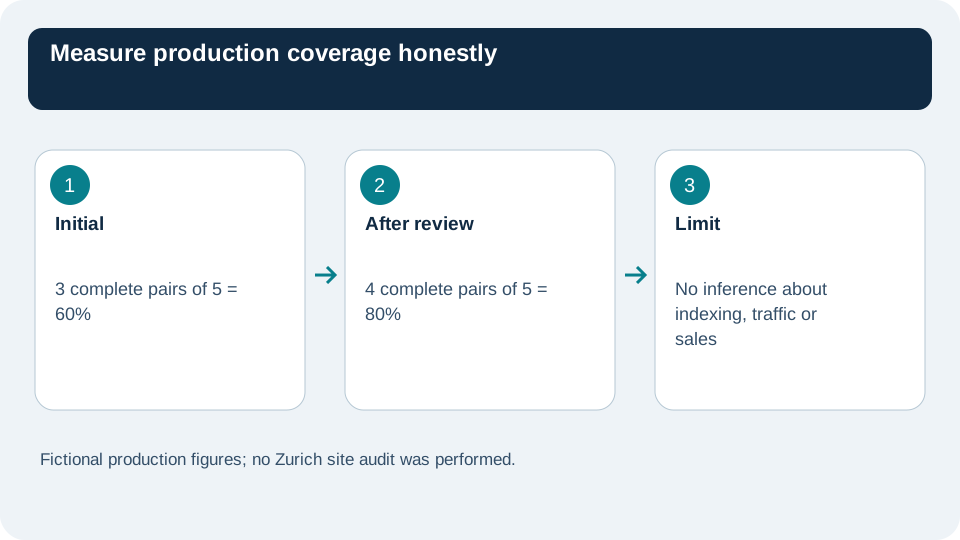
In our conceptual set, P1, P2 and P3 are reviewed in French and German. P4 exists only in French. P5 has an incomplete German draft. Three of five complete pairs gives a production coverage of 60%. This is not an indexing rate or measure of traffic in Zurich.
| Fictional subject | French state | German state | Publishing action |
|---|---|---|---|
| P1 | Reviewed | Reviewed | Connect equivalent pages |
| P2 | Reviewed | Reviewed | Compare shared facts |
| P3 | Reviewed | Reviewed | Check the language selector |
| P4 | Reviewed | Absent | Do not announce a pair |
| P5 | Reviewed | Incomplete | Finish and review the draft |
Keep incomplete pages outside the set offered as finished equivalents. An automatic annotation built from a planned slug can misrepresent publication readiness. The register should drive the available relationships, not the expectation that every subject will eventually have every language.
Verify the final URLs before technical annotation
Open the intended URLs and check that they resolve to the correct content. Record redirects, accessibility and the final address. A counterpart that redirects to the homepage does not establish the same answer. Fix the mapping before adding it to a language set.
Google's localized-version documentation explains hreflang language signalling, including self-references and return relationships between versions. Use complete URLs and supported language codes according to that guidance. A language-country code such as de-CH should reflect actual targeting rather than be added to every German page by habit.
The annotation does not translate the content or guarantee which version appears in search. Its usefulness depends on a correct set of real counterparts. Treat the content review and technical review as connected checks, with separate evidence for each.
Review canonical and language signals for different purposes
Canonicalisation deals with preferred versions of duplicate or very similar URLs; language annotations describe localized relationships. Do not assume one instruction replaces the other. Review the actual strategy for translations and regional variants before applying a sitewide rule.
A blanket canonical from every translated page to French can conflict with the intention to make distinct translations available. Ask the technical maintainer to explain the declared and observed signals on representative pages. Similar same-language regional pages may need a different assessment from complete translations.
Inspect the rendered page and any sitemap implementation used by the site. A correct source template does not prove that every generated entry references the final URL. Keep the implementation method consistent and record the relationship set checked for each subject.
Cross-review the facts that affect the reader's decision
Compare price and currency, variant, measurement, availability, preparation and returns where relevant. The linguistic reviewer needs the original evidence. A smoother phrase can become stronger if it turns a possibility into a guarantee; readability does not justify that change.
Preserve deliberate adaptations too. An idiomatic example or clearer local term may differ without changing the central answer. Record the choice so a later reviewer does not restore a literal expression that is less useful. The goal is consistent meaning, not identical sentence structure.
Check images and downloads alongside text. A translated page can still point to a document with obsolete facts or labels. The equivalent record should identify the resources that need review when a shared attribute changes.
Check the selector as a customer journey
From each published version, use the language control and confirm that it leads to the counterpart, not simply the other language's homepage. Check the reverse route too. Preserve the user's relevant context where the actual system supports it.
When a counterpart is absent, the interface should not imply it is available. You might offer a clearly labelled language homepage as a separate navigation choice, but it should not masquerade as a translation of the current article. Choose the behaviour deliberately and make the destination understandable.
Use representative mobile and desktop views. A correct URL map is still difficult to use if the selector is hidden, ambiguous or inaccessible in the layout. Record that observation as a usability issue rather than pretending language annotations alone solve the journey.
Review every shared change across the set
Assign an owner to each equivalent set and note when shared facts were reviewed. A supplier change or corrected procedure should identify every language affected. Updating only the source page can leave an inaccurate translation active for a long time.
If P5 becomes complete in our fictional register, the pair coverage rises to four of five, or 80%. Recheck the four published sets and their relationships. The production improvement does not establish successful indexing, correct search targeting or additional sales.
Start with five representative subjects and verify the register, shared facts, final URLs and selector. Publish only the versions genuinely ready to support the reader. Multilingual SEO becomes maintainable when equivalence has an owner and evidence, while missing languages remain honest gaps rather than fabricated completeness.

Audit and Fix Your Website
Explore this related DIY Marketing Guide guide to work further on the method. DIY is part of our business group; contents, language and price are shown on its store.
See the English guide