
A blog can combine sponsorship income with paid DIY guides when readers receive useful editorial work and understand commercial relationships. Sell a defined publishing service or a documented learning outcome. Use real audience evidence, explicit terms and retained revenue to evaluate the model rather than promising search rankings.

In this article
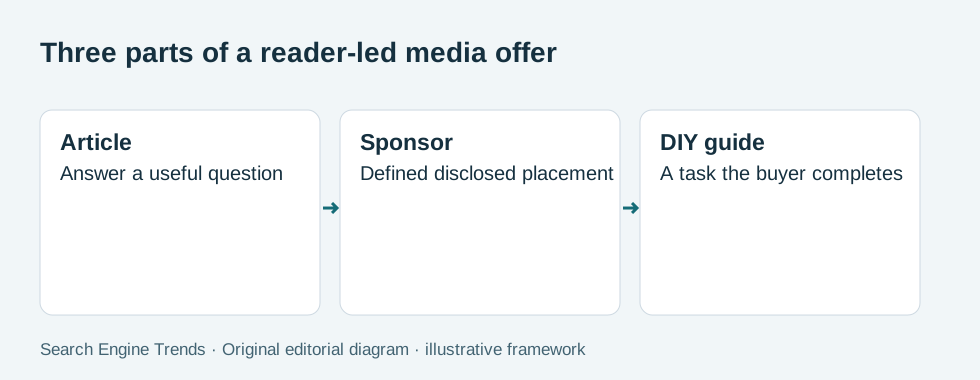
A business blog can earn revenue from sponsors and practical ebooks while keeping its editorial value clear. The foundation is an audience with identifiable questions, a publishing service sponsors can inspect, and a guide that helps readers complete a specific task. Revenue should be modelled with costs and refunds, not treated as a consequence of publishing more articles.
This guide uses a hypothetical international media business. Its examples are planning assumptions, not Search Engine Trends’ audience statistics, sponsor prices or achieved sales.
Define the reader outcome before the revenue channel
Choose a recurring reader problem the publication can answer well. For example, a small retailer may need to compare packaging costs, prepare a category page or review a marketing report. These are different editorial jobs, and they can support different commercial products.
A free article should still deliver its stated answer. A paid guide can add a deeper worked example, an editable worksheet, an organised process or troubleshooting instructions. Hiding every useful step behind a payment prompt makes it difficult for readers to judge the quality of the paid material.
Map each product to a completion test. “Calculate a parcel-cost comparison using the reader’s own invoices” is stronger than “become an ecommerce expert”. The first can be supported with instructions and a calculation sheet; the second requires a much broader body of evidence.
Begin with one relevant paid offer and one sponsor format. This makes delivery effort easier to observe. Additional channels can follow once the publisher knows which questions create purchases and what support those purchases require.
Build a media kit from evidence the publisher actually has
A sponsor needs to know who the publication serves, what will be published, where it appears and what can be reported afterward. Provide actual figures with their period and definitions. Distinguish page views, sessions, email subscribers and social followers instead of combining them into an inflated audience total.
When evidence is limited, state the positioning and editorial scope without pretending it is measured reach. “Content for independent retailers in English and French” can describe an editorial direction. “Thousands of qualified buyers in four countries” requires appropriate supporting data.
Set out the proposed deliverable: article length and subject, placement, publication period, review rights, disclosure, permitted assets and reporting. Sponsor factual review can check product names and supplied claims; it should not quietly convert an independent comparison into a predetermined endorsement.
Avoid promising rankings, organic traffic or AI citations. The publisher controls production and placement on its own site, not the decision of a search engine or a reader. A commercial contract should describe the service within that control.
If a sponsor supplies a performance claim, request its source and scope. “Compatible with system X” requires a defined version or specification. “Cuts costs by half” needs a documented comparison. Unsupported claims can be omitted even when their inclusion would make the advertisement easier to sell.
Make commercial relationships visible in the actual article
Place an understandable sponsorship or advertising disclosure where readers encounter the commercial content. Do not rely on a separate policy page to explain a relationship that affects a particular recommendation.
For content reaching US consumers, FTC endorsement guidance addresses disclosure of material connections. For relevant UK affiliate advertising, ASA guidance explains the need for advertising to be recognisable. These references have different jurisdictional scopes; review the obligations applicable to the actual publication and campaign.
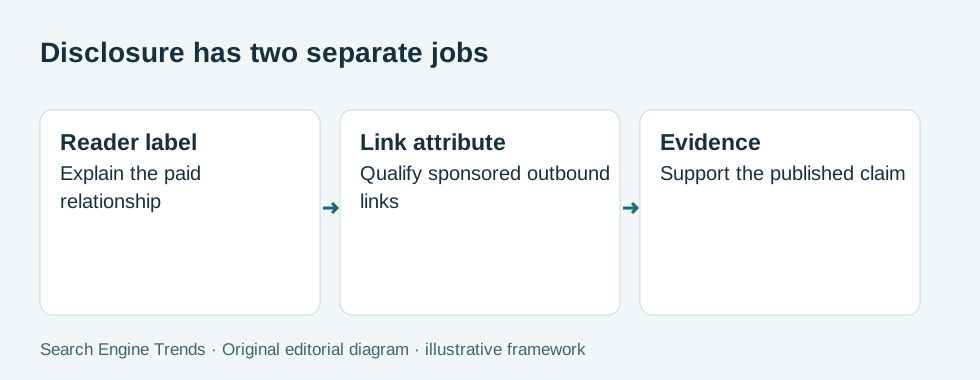
Reader disclosure and link attributes serve different purposes. Follow Google’s outbound-link guidance to qualify advertising or paid placements with rel="sponsored". The attribute does not replace the visible explanation readers need.
Apply the same principle to an ebook review containing affiliate links. Explain the relationship and keep the recommendation grounded in the guide’s actual scope. Do not describe an untested product as personally used, independently verified or proven to deliver results.
Compare revenue with an explicit hypothetical cost model
Suppose an imaginary publisher sells two sponsorship packages at USD 500 each and thirty guides at USD 19 each. All amounts below are illustrative, with no assumption that these prices or sales volumes are achievable.
| Hypothetical monthly item | USD | Interpretation |
|---|---|---|
| Two sponsorship packages | 1,000 | Gross billed amount in this scenario |
| Thirty guide sales | 570 | Thirty multiplied by nineteen |
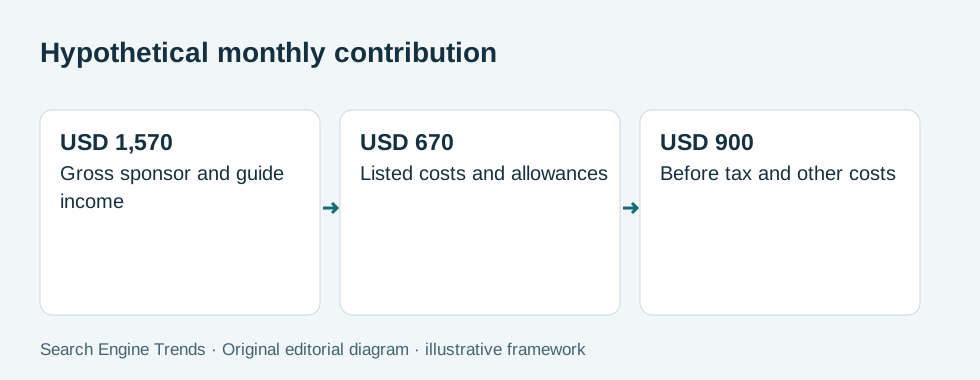
| Combined gross income | 1,570 | Before the listed costs and allowances |
| Editorial production | −400 | Assumed production effort allocation |
| Distribution expenditure | −120 | Assumed promotional cost |
| Payment and platform costs | −60 | Illustrative allowance, not provider pricing |
| Support and refund allowance | −90 | Hypothetical expected burden |
| Remaining contribution | 900 | Before tax and other unlisted costs |
The contribution is 1,570 minus 670, or USD 900. It is not take-home profit: software, general administration and other costs may still apply. Replace every assumption with the publisher’s actual terms before using the worksheet for a business decision.
Stress-test the sponsor component separately. With only one sponsorship, the same model begins at USD 1,070 gross. If all listed costs remained unchanged, contribution would fall to USD 400. In practice, some costs may change; document which are fixed and which depend on sales or deliverables.
A guide also has a creation cost. If that cost is spread across an unrealistically large future sales total, its apparent profitability can hide a weak launch. Show the initial production outlay alongside the monthly operating model rather than assuming it has already been recovered.
Measure trust, delivery and retained income together
Define a sponsor report before agreeing the campaign. If the package includes article views and tracked outbound interactions, explain how those figures are collected and what they exclude. A click on a sponsor link is not a confirmed lead or sale at the destination.
For an ebook, reconcile paid orders, delivered access, support requests and refunds. Shopify’s digital-product documentation provides a platform-specific starting point when that system is used. The publishing team must still verify its own files, product mappings and reader instructions.
Review complaints by cause. An unclear purchase description needs a copy correction; an inaccessible file needs delivery support; a flawed calculation needs content review. Counting all three as generic “engagement” conceals problems that have different remedies.
Blog monetisation checklist
- Define the audience and the useful paid outcome.
- Use measured audience figures with periods and definitions.
- Document the sponsor’s deliverable and review limits.
- Disclose each material commercial relationship clearly.
- Qualify paid outbound links appropriately.
- Test the guide’s purchased-file journey.
- Reconcile income with production, distribution, support and refunds.
Use a small pilot to establish delivery costs and reader response. The objective is a commercial product the publisher can fulfil consistently, with enough evidence to decide whether to repeat, revise or stop it.
FAQ
Can a small blog accept sponsors?
Yes, if its offer describes its actual audience evidence and defined publishing service honestly. A smaller audience does not justify fabricated reach or guaranteed outcomes.
Should sponsored articles be excluded from useful editorial work?
They should still be accurate and useful within the disclosed commercial relationship. Label the relationship and apply the same requirement for substantiated claims.
Is an ebook sale automatically profitable?
No. Consider creation, acquisition, platform costs, support and refunds. Gross sales describe receipts before those costs, not the business’s final profit.
Backlinks and Link Acquisition
Explore this related DIY Marketing Guide guide to work further on the method. DIY is part of our business group; contents, language and price are shown on its store.
See the English guide