
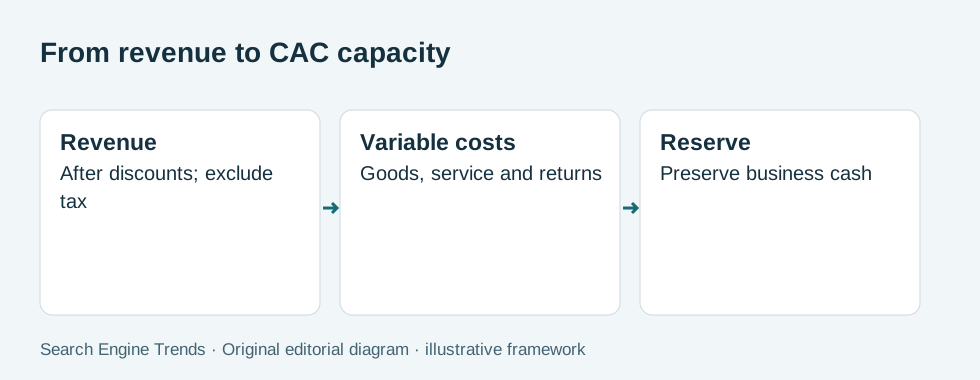
Set a customer acquisition cost ceiling from the contribution a new customer can realistically generate. Deduct product, fulfilment, payment and expected return costs first, then preserve the cash you need for overhead and uncertainty before funding another acquisition.

In this article
Austin customer acquisition cost becomes useful when it connects spending to retained contribution, not just revenue. Calculate what a first order leaves after variable costs, then decide how much of that amount can fund acquisition. Treat hoped-for repeat purchases as a separate scenario until your own customer cohorts support them.
Define the customer and the cost window
For a hypothetical Austin online store, a new customer means a buyer placing a first completed order during the measured period. A new email subscriber is a lead. An existing buyer using a different browser is not automatically a new customer. Establish these definitions before comparing an ad report with the commerce database.
Choose a cost scope. Media-only CAC divides advertising spend by attributed new customers. A broader acquisition measure can include campaign production, agency work and acquisition-specific tools. Both can be useful if their labels are clear; mixing them makes one channel appear cheaper because its work sits outside the numerator.
Google’s ecommerce measurement guide provides event guidance for purchases and refunds. Your order ledger remains necessary for checking whether attributed transactions became retained business.
Build three controls into the spending decision
Use a common reporting window and a visible assumptions sheet. Acquisition teams should know which costs are estimates, which have been reconciled and which orders remain inside the return window. The cap should change when evidence changes, rather than because a dashboard color turns green.
Customer denominator
Who counts as a newly acquired paying customer? Use first completed orders from the commerce records and document how cancellations are treated. Compare that count with channel attribution without assuming the two systems match exactly.
Check against a reconciled first-order count for the reporting window. If the ad platform reports more new buyers than the order records can substantiate, review the affected case before continuing. Attribution is a measurement model; the spending cap must still relate to customers the business actually served.
Contribution inputs
What remains after delivering and retaining the first order? Deduct item cost, discounts already excluded from revenue, actual shipping subsidy, payment costs and expected return effects. State which inputs are provisional.
Check against a per-order contribution worksheet with a return assumption. If a gross sales figure is being used as available acquisition money, review the affected case before continuing. Revenue collected for taxes and money needed to serve the customer cannot safely fund another campaign.
Scaling decision
What cash and evidence support an increase in spend? Compare the current cap with retained contribution and the forecast payment calendar. Change one budget step at a time while watching product mix and refund exposure.
Check against a spending decision with a downside cash case. If the reserve would be consumed before repeat purchases are expected, review the affected case before continuing. A profitable projection is not the same as enough cash to fund fulfillment and refunds today.
Work through an explicitly hypothetical cap
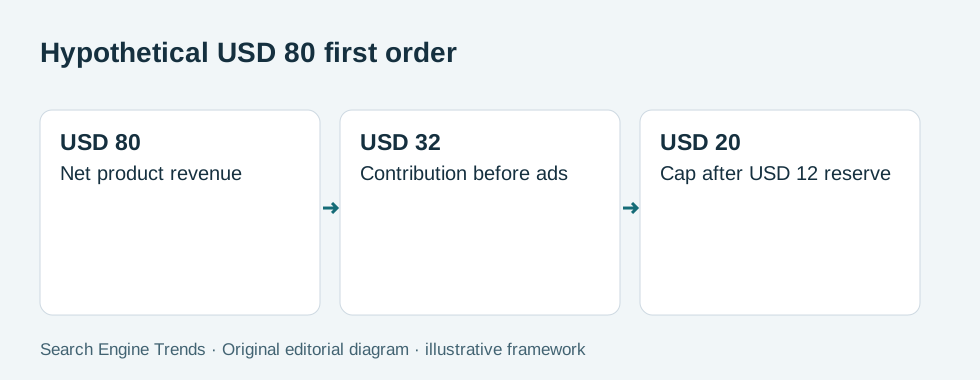
Assume a first-order revenue of USD 80 after discounts and excluding sales tax collected for authorities. Product cost is USD 28, fulfillment and shipping subsidy USD 10, payment-related costs USD 3, and an expected return allowance USD 7. Contribution before acquisition is USD 32. Reserving USD 12 for overhead, uncertainty and the owner’s target leaves an illustrative CAC cap of USD 20.
| Hypothetical input | USD per first order |
|---|---|
| Net product revenue | 80 |
| Product and variable service costs | 41 |
| Expected return allowance | 7 |
| Contribution before acquisition | 32 |
| Business reserve | 12 |
| Illustrative acquisition cap | 20 |
These inputs are invented for explanation, not Austin benchmarks. Replace the shipping subsidy with the amount the store actually absorbs and avoid deducting a return cost twice. A higher-margin basket may support a different cap; do not apply the USD 20 figure to every product or season.
Compare profitability with cash timing
A campaign can meet a lifetime profitability target while creating a short-term cash shortage. Supplier payments, advertising charges and refunds can precede repeat-order contribution. Forecast when money leaves and when retained receipts become usable. Keep a working cash buffer separate from the theoretical lifetime value.
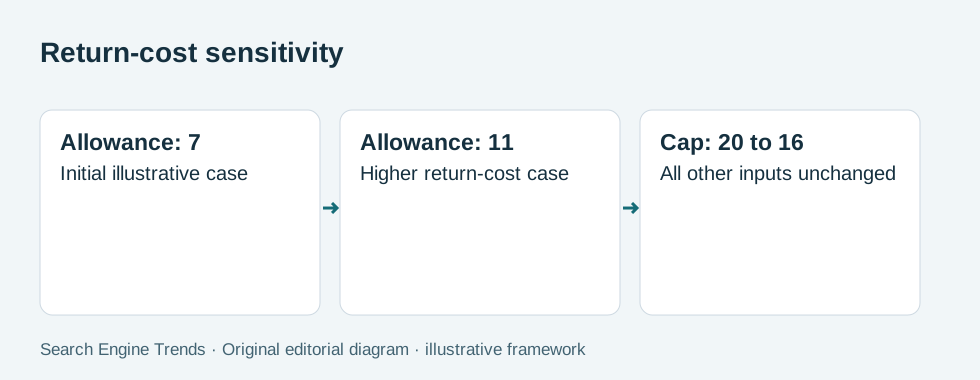
For sensitivity, increase the illustrative return allowance from USD 7 to USD 11. The available acquisition amount falls from USD 20 to USD 16 if the other inputs remain unchanged. This is a concrete reason to review product quality and return causes before scaling traffic.
Measure retained contribution per acquired customer alongside CAC. If one channel brings larger initial baskets but many cancellations, the apparent revenue advantage can disappear. Evaluate enough completed orders to see the pattern and state uncertainty for small cohorts instead of presenting a precise cap as a universal answer.
Reconcile a small campaign before scaling it
Take a hypothetical USD 600 acquisition campaign and thirty eligible new buyers. Its observed CAC is USD 20 under the chosen cost scope. If five of those initial orders are excluded under the store's documented cancellation convention, the eligible count falls to twenty-five and the same spending becomes USD 24 per eligible buyer. The campaign's media report may not make that adjustment automatically.
Now check whether the return allowance already accounted for those cancellations. Deducting their full effect from the customer count and again from contribution can create an inconsistent model. Preserve one convention and show why the provisional and final figures differ.
Use this reconciliation to decide the next budget step. If the final CAC exceeds the first-order cap, identify whether the problem came from acquisition cost, product contribution or order quality. A better advertisement cannot fix a basket whose discount leaves too little contribution, and a higher average selling price does not help if refunds erase it. Each diagnosis implies a different next experiment.
Checklist for an acquisition review
- Count first-time completed buyers with a stable definition.
- Label media-only and broader acquisition costs separately.
- Reconcile discounts, cancellations and refunds.
- Deduct the actual variable cost of serving the basket.
- Show a first-order case before adding repeat-purchase assumptions.
- Check cash timing and preserve a defined reserve.
- Reduce the cap when product mix or return costs deteriorate.
Build a worksheet that exposes these inputs. A practical ebook or internal playbook can help the team repeat the calculation, but it should teach the method rather than promise a universally profitable advertising number.
FAQ
Is ROAS enough to approve a campaign?
ROAS compares attributed revenue with advertising spend. It does not show product costs, refunds or the contribution left to cover the rest of the business.
Can future repeat orders justify a higher CAC?
They can inform a documented scenario once your own cohorts support the timing and contribution. Keep a downside case where those orders do not arrive.
How often should the cap change?
Review it when meaningful inputs change, including product mix, shipping costs, returns or acquisition scope. Recalculating daily from a few orders can create false precision.