
Invite honest reviews using a consistent rule and neutral wording rather than selecting only satisfied customers. For a store serving Bristol, distinguish private support from public feedback, preserve negative experiences, and measure invitation delivery, responses and publication as separate stages.

In this article
- Make the invitation independent of the desired rating
- Define a trigger based on the customer experience
- Write an invitation that explains the destination
- Separate moderation from satisfaction management
- Reply without exposing the customer's order
- Measure the stages with their own denominators
- Read themes alongside scores
- Check the rule on a small set of cases
Make the invitation independent of the desired rating
An invitation should let a customer describe the experience freely. Asking only people who seem happy creates a selected picture of the service. A neutral rule makes the collection easier to explain and gives the business access to problems that a positive-only process would hide.
This guide uses a fictional store serving Bristol. No real review, customer quotation or local satisfaction statistic is presented. The quantities are invented to illustrate process measurement. No gifts, fabricated comments or promises of a particular rating are proposed.
Consult the CMA's current fake reviews guidance and the chosen platform's rules before implementing an invitation or publishing process. The operational steps below help document the selection and handling of feedback; they do not replace the requirements applying to your actual activity.
Define a trigger based on the customer experience
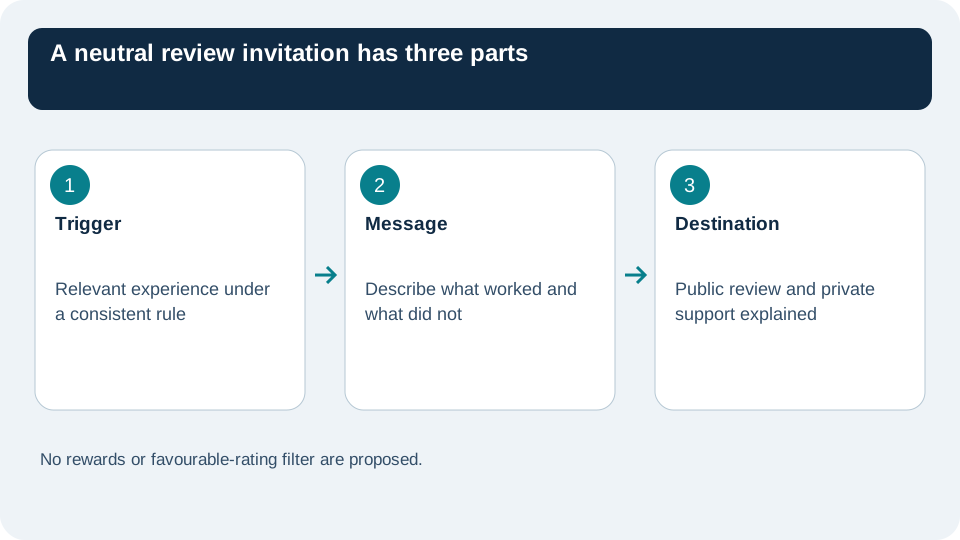
Choose which orders receive an invitation and the event that makes the request appropriate. Payment may be too early for feedback about use. Confirmed receipt can be a better starting point, although some products need more time before the customer can assess them.
Document the trigger and the reason for it. Keep legitimate operational exclusions visible, such as an invalid contact address or a recorded preference not to receive the message, according to the rules applying to your use. Do not turn those exclusions into a hidden test of likely satisfaction.
A refund or support contact does not automatically make an experience irrelevant. The customer may have useful information about choosing, delivery or resolution. Review the selection rule across different case types so the invitation is not quietly removed whenever a low rating seems possible.
Write an invitation that explains the destination
State which product or order the request concerns, why you are asking and where the link leads. A reader should know whether the response will be public or used privately by support. Ambiguity at this stage can create concern even when the business intended a simple request.
A neutral message might ask what worked and what could be improved. It should not ask for five stars or frame a positive rating as a way to help a vulnerable employee. Participation remains a choice. The goal is an account of the experience, not a particular score.
| Message element | Useful approach | Problem to avoid |
|---|---|---|
| Purpose | Describe the experience | Request a specific rating |
| Destination | Public review clearly identified | Imply everything stays private |
| Support | Separate contact route | Require support before reviewing |
| Choice | Voluntary participation | Emotional pressure |
| Reward | None in this method | Gift dependent on a positive score |
If support is offered in the same message, keep it independent. A dissatisfied customer should understand both routes without being forced through a private resolution before sharing public feedback. Check the actual destination and wording rather than only the email template name.
Separate moderation from satisfaction management
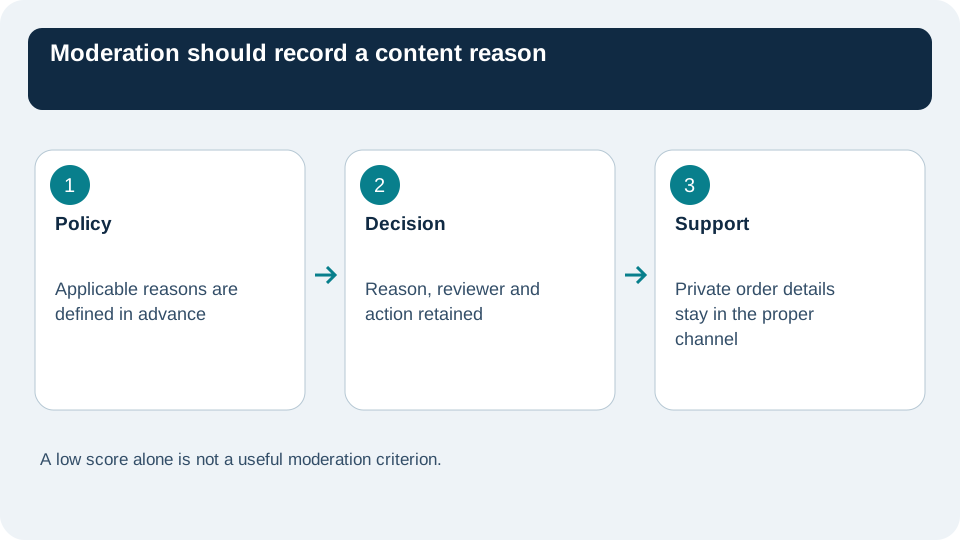
Define moderation reasons according to the applicable rules and platform policy. Personal information, irrelevant content or another stated content issue may require attention. A low rating by itself should not become an internal reason to erase a useful account of the experience.
Record the reason, decision and reviewer when content is held or removed. The log should distinguish a content-policy problem from an operational delay or unknown status. This allows someone else to inspect the process without relying on the moderator's memory.
If you host reviews, examine the measures required to assess and address authenticity under the current guidance. A verified-review badge should describe a real process. Simply adding the label does not prove that the reviewer bought the product or that the text has been checked appropriately.
Reply without exposing the customer's order
A public response can acknowledge the issue, explain the next step and offer an appropriate contact route. It should not reveal an address, payment detail or private order history to win an argument. Keep the case details in the channel needed to resolve the problem.
Prepare responses for missing information, a reported defect and an unclear instruction. The tone should support investigation rather than assume the customer is wrong. Where the business later corrects a fact, record the change internally and avoid rewriting the customer's words to match the improved offer.
The support team also needs a way to connect the public conversation to an internal case without duplicating unnecessary personal details. Review access and retention arrangements for the actual process. A shared content sheet does not need every piece of information contained in the order system.
Measure the stages with their own denominators
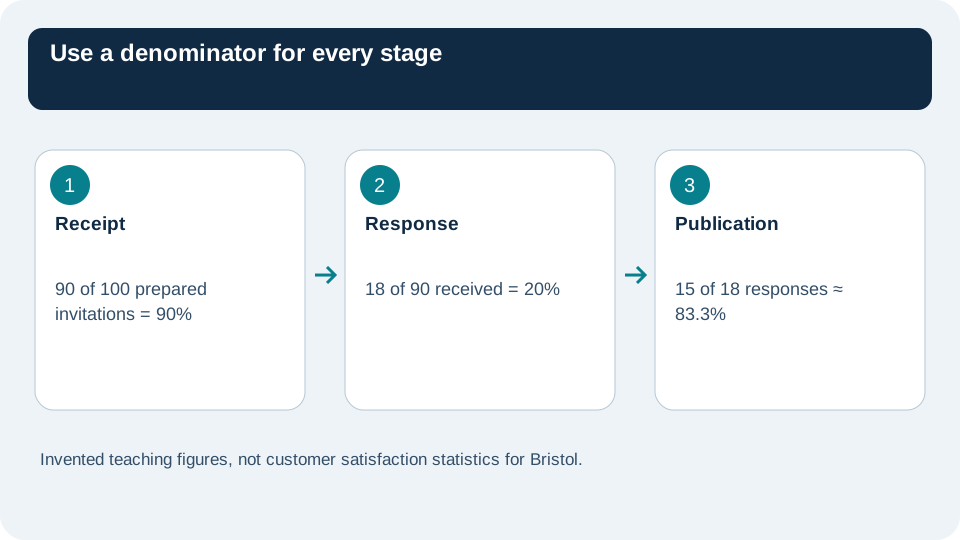
In an illustrative scenario, one hundred invitations are prepared, ninety are recorded as received, eighteen people respond and fifteen reviews become visible. These stages produce different ratios. Recorded receipt is 90% of prepared invitations. Response is 20% of received invitations. Publication is about 83.3% of responses.
These invented figures are not Bristol benchmarks. They show why a single review count does not describe the collection process. The meaning of received also depends on the measurement available; an email delivery indicator does not necessarily prove that the customer read the message.
A missing publication may reflect a platform delay, a policy decision or a response intended for private support. Do not assume suppression or dissatisfaction without checking. Keep an unknown category where evidence is absent and avoid changing the denominator to make the process look better.
Read themes alongside scores
Group feedback by product selection, preparation, delivery, use and instructions. A single comment can justify a check without establishing a widespread defect. Repeated descriptions of the same ambiguity should be compared with the actual product page and source documents.
Present an average rating with the number of reviews and period. Fifteen reviews do not represent every customer. Mixing ratings for different products or versions can conceal an important difference. Keep those boundaries visible when deciding what to improve.
If you revise a dimension or instruction, date the change. Earlier reviews may describe the previous offer. This chronology helps the team understand the feedback without removing historical experiences simply because the page now looks better.
Check the rule on a small set of cases
Review the invitation wording, destination and selection criteria. Examine ten anonymised or simulated cases, including support requests and refunded orders, to confirm that the rule does not screen for positive experiences. This is a proposed check; no customer records were inspected for this example.
Improve the stage that causes confusion, while preserving the customer's freedom to describe the experience. A useful review process helps the business find clearer instructions and better service. Its credibility comes from consistent selection and honest handling, rather than a mechanism designed to manufacture favourable ratings.