
A useful product bundle combines items that support one clear task, with accurate contents and a verifiable price comparison. For a shop serving Leeds, check compatibility, calculate the contribution and track component quantities before offering a pack alongside the same items sold separately.

In this article
- Build the bundle around a task
- Give every component a documented role
- Calculate a saving from real comparable prices
- Distinguish customer saving from seller contribution
- Find the component that limits availability
- Make substitutions visible and deliberate
- Review usefulness through questions and incidents
- Start with a pack you can explain and maintain
Build the bundle around a task
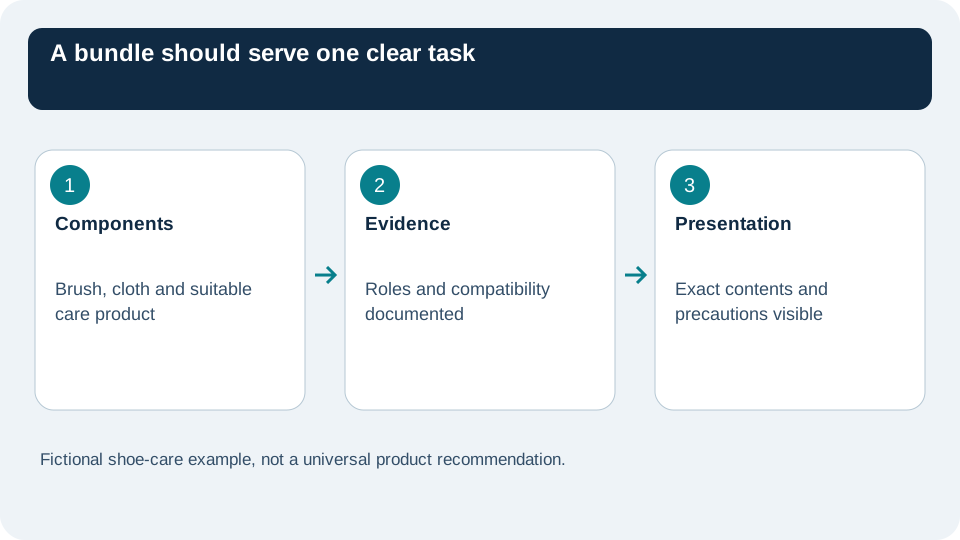
A bundle should help a customer complete something understandable. Putting three unrelated products into one offer may raise the basket value without simplifying the choice. Start with the task, identify the necessary components and explain what each contributes before deciding whether a discount is useful.
Our example is a fictional shoe-care set for a shop serving Leeds: a brush, a cloth and a product whose suitability must be checked against the manufacturer's instructions. It does not recommend a chemical formulation or claim universal compatibility with every material. The GBP prices and quantities are invented for the calculation.
Treat the bundle as its own offer. Its contents, component quantities, variants and preparation must be accurate. The photograph should show the items actually delivered. If a component changes, the bundle page and its instructions need the same attention as an individual product page.
Give every component a documented role
For the brush, explain the stage it supports when suitable for the material. For the cloth, show the action described by the relevant instructions. For the care product, preserve its own uses and precautions. A bundle description must not remove warnings simply to make the pack sound convenient.
Check whether different materials or variants require different combinations. If you offer several sets, explain the selection criteria instead of relying only on names such as standard and premium. A customer should understand why a different component is included and when it is appropriate.
Prepare a source file with reference, quantity, purpose and compatibility evidence. Where the evidence is missing, obtain clarification before publishing the claim. A matching colour scheme or similar packaging is not proof that the products are suitable for use together.
Calculate a saving from real comparable prices
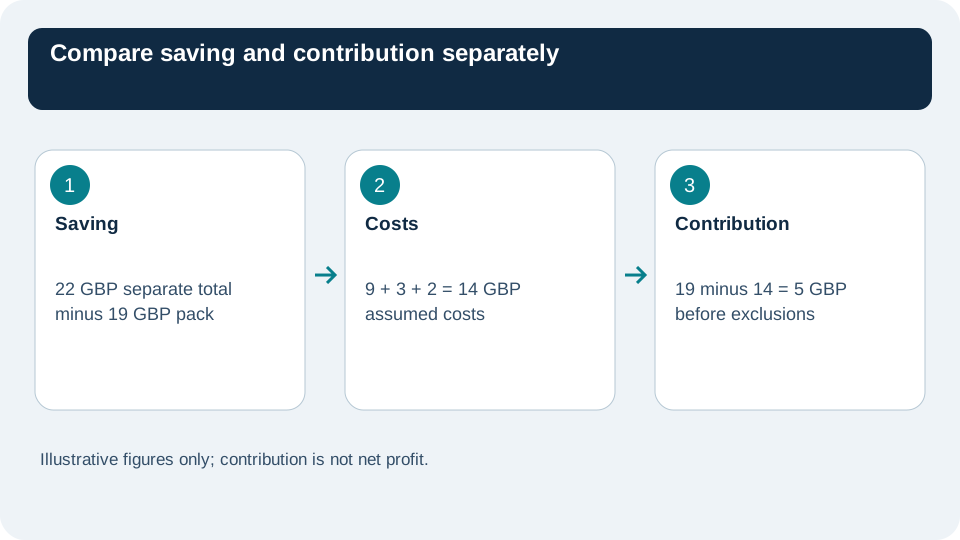
In our illustrative offer, the brush costs 8 GBP separately, the cloth 4 GBP and the care product 10 GBP. The total is 22 GBP. A pack priced at 19 GBP has a difference of 3 GBP, or approximately 13.6% of that total. This calculation is valid only if those separate prices apply to the same items and quantities in the actual comparison.
| Illustrative item | Separate price | Fact to verify |
|---|---|---|
| Brush | 8 GBP | Suitable use and exact reference |
| Cloth | 4 GBP | Quantity and role in the process |
| Care product | 10 GBP | Compatibility and precautions |
| Separate total | 22 GBP | Current like-for-like basis |
| Bundle | 19 GBP | Difference of 3 GBP |
Do not create a saving from a price that is unavailable, outdated or associated with a different reference. Keep the calculation beside the offer record. When the pack changes, revise the comparison, images and wording together so an old saving does not survive a new composition.
Distinguish customer saving from seller contribution
The price comparison explains what the customer pays. It does not explain whether the pack is sustainable for the seller. Add the cost of each component, assembly, packaging, payment and any delivery funded by the business. A bundle may reduce some preparation while adding another handling step.
Suppose the components cost 9 GBP together, preparation and packaging 3 GBP, and other included variable costs 2 GBP. Against an illustrative 19 GBP revenue, the simplified contribution is 5 GBP before excluded costs. This is not net profit and does not represent a Leeds market price.
Compare with separate sales using a consistent basket and cost convention. A customer who would have bought all three items anyway may simply receive a lower price. Another customer may benefit from a clearer complete selection. Observe which situation occurs rather than assuming that a higher basket value proves added usefulness or margin.
Find the component that limits availability
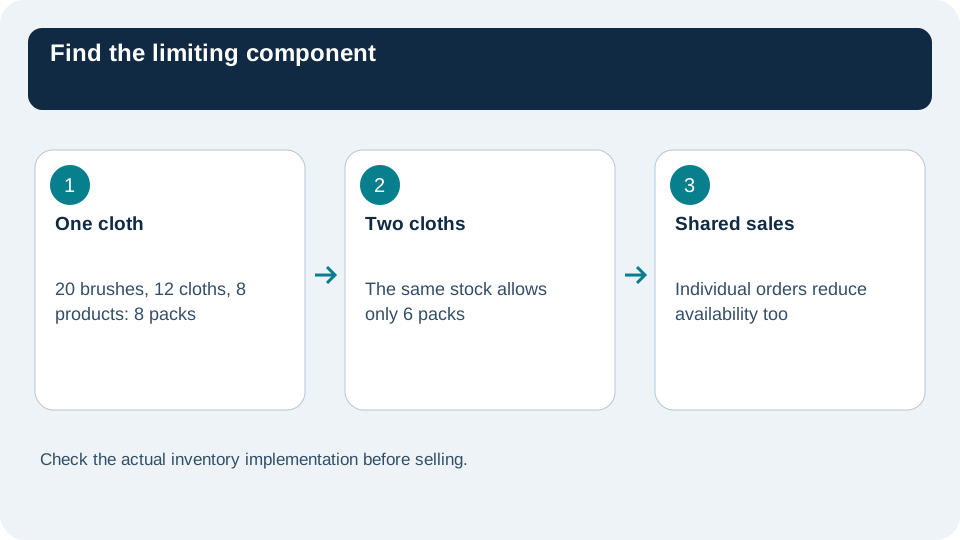
Imagine twenty brushes, twelve cloths and eight care products available before other reservations. With one of each per pack, the theoretical limit is eight packs. If each pack requires two cloths, the cloths allow six packs and become the limiting component.
The rule is to compare available quantity with quantity required per pack for every component, then take the lowest feasible whole number. Use quantities that reflect the actual inventory state. Units already engaged in separate orders cannot also be promised in bundles.
Shopify's bundle considerations explain constraints and availability handling in its environment. Check your actual tool and configuration. The existence of a bundle feature does not prove that every stock change, integration or sales channel behaves as your operation requires.
Check simultaneous sales and cancellations
Prepare a scenario where one component sells individually while another customer chooses the bundle. Examine the availability shown, the quantities engaged and the result of cancellation. The bundle and individual listings must draw from the intended stock relationship.
Also check a partial return or a refund affecting one component, using the rules and capabilities applicable to the real sale. Do not assume that the pack price divides equally among items or that the software restores every component automatically. Document how quantities and financial records will be reconciled.
These are proposed operational checks, not tests completed for a Leeds shop. Run them in a suitable environment and retain the observations. If the tool cannot represent your intended pack safely, change the composition or process before accepting real orders.
Make substitutions visible and deliberate
When a component runs out, do not quietly replace it because another product looks similar. Confirm compatibility, quantity and customer information for the proposed change. Update the description and image, and review any saving claim that relied on the previous separate price.
Keep the old and new bundle versions identifiable. A customer question may refer to the pack sold before the change. The team needs to know which contents were promised for that order. Version tracking is particularly useful when individual references remain on sale alongside the revised set.
Review usefulness through questions and incidents
Track missing components, preparation errors, compatibility questions and returns alongside confirmed bundle sales. A larger basket can conceal confusion about what the set includes. The questions customers ask often reveal where the choice or instructions need improvement.
In an invented run of twenty packs, two compatibility enquiries produce a rate of 10%. This number describes only the example. Examine the relevant wording and documents instead of replacing it with an assumed industry average. A complete contents photograph may help when it accurately represents the delivered set.
Start with a pack you can explain and maintain
Choose one task, a compatible component set and a transparent cost sheet. Prepare several simulated orders with different variants and inspect the instructions, quantities and inventory effect. Make the offer available only when its contents and fulfilment can be represented correctly.
A discount is optional; a clear and useful combination is essential. The bundle earns its place when it makes the customer's task easier while preserving accurate facts and a workable contribution. Review those conditions whenever the components, costs or availability change.