
A valid ZIP code does not establish that a basket can be delivered. For a large-item store serving Phoenix, check address quality, the actual commercial zone and the service available for the packed goods, then verify the checkout response for representative address and basket combinations.
In this article
- Separate postal validity from delivery availability
- Build three layers of validation
- Prepare an address-and-basket matrix
- Check boundaries and difficult input
- Measure the closed parcel for each representative product
- Confirm the quote and the order record
- Make rejection messages actionable
- Measure case coverage by failure type
Separate postal validity from delivery availability
A ZIP code helps identify a postal destination. It does not establish that your chosen service accepts the address, parcel or complete basket. Delivery eligibility depends on several conditions that should remain distinct in the customer interface and internal checks.
The example concerns a fictional seller of larger objects serving Phoenix. No street address, local route or delivery result is invented. Test cases are labelled A, B and C rather than presented as actual ZIP codes. No travel time or arrival commitment is supplied.
A nearby address may receive a different response under a service's conditions or a commercial zone rule. Keep the source of each rule visible. A map, postal lookup and carrier quote answer different questions; none should silently substitute for the others.
Build three layers of validation
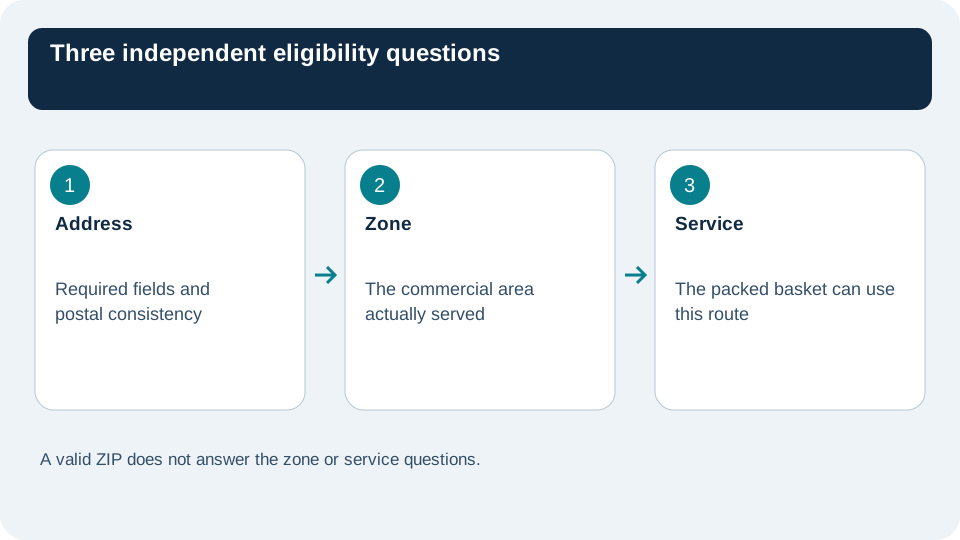
The first layer concerns address quality: required fields, postcode and consistency. The second is the commercial area your business really intends to serve. The third is the available service for the packed product and basket. Passing the first layer does not automatically pass the next two.
The USPS PostalPro ZIP lookup guidance points to official address-based lookup. Use it to check a postal element when appropriate. It does not replace confirmation of your carrier's eligibility or your own fulfilment capacity.
Record the source, date and scope of the zone and service decisions. If a carrier confirms a condition for one parcel format, do not extend it automatically to every item. A rule with no recorded basis should be reviewed before it becomes a public promise.
Prepare an address-and-basket matrix
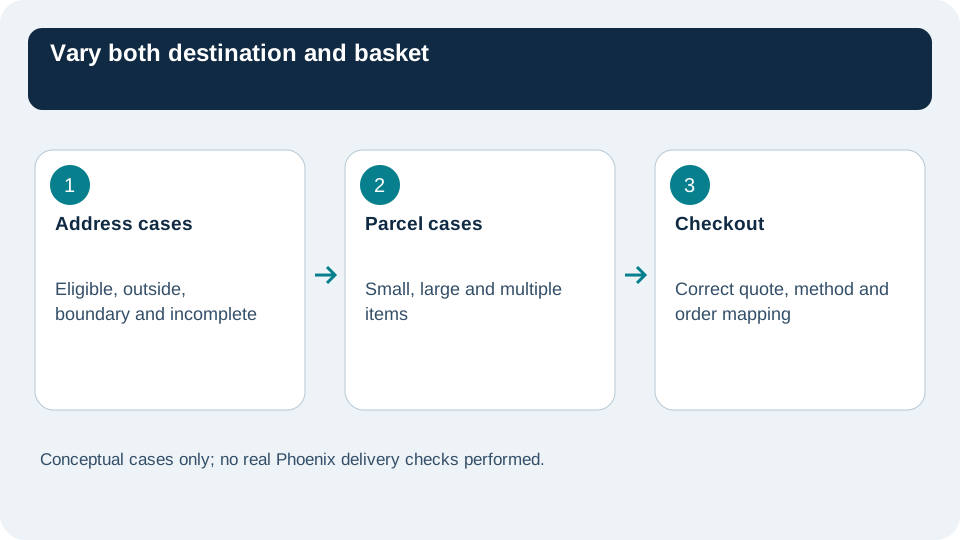
Imagine two fictional products: a small support and a larger piece of furniture. Address A is a conceptual eligible case, B is outside the intended zone and C is incomplete. The matrix describes responses to verify in an appropriate environment, not results obtained from a real Phoenix checkout.
| Illustrative case | Address state | Basket | Expected check |
|---|---|---|---|
| A | Complete and commercially eligible | Small support | Applicable service and quote |
| B | Valid but outside the zone | Small support | Clear refusal or real alternative |
| C | Incomplete | Small support | Request the missing information |
| A with large item | Eligible | Large object | Compatible service confirmed |
| A with two items | Eligible | Multiple items | Correct parcel composition |
A service button appearing is not enough. Check that its price and conditions correspond to the actual goods and that the order can be fulfilled through the selected route. A technically selectable method may still be operationally inappropriate.
Check boundaries and difficult input
Use authorised test addresses covering the interior, exterior and edge of the zone. Inspect spaces, character handling and formats accepted by the actual system. Normalisation should not silently alter an address so substantially that the customer cannot confirm the result.
Include a unit or apartment when relevant to the address. Verify that the field survives checkout, the order record and the export to the service provider. A form can accept the text while a later integration drops it. Review the whole path, not only the initial validation message.
Limit access information to the logistics need. A technical test sheet can use case identifiers rather than full customer details. Keep any real address evidence in the authorised system and use the minimum information required to reproduce a problem.
Measure the closed parcel for each representative product
The service should receive dimensions and weight that describe the parcel actually handed over. A supplier's product dimensions do not necessarily describe the packed object. Measure a representative closed parcel using the process required by the carrier, then record the source and date.
One item and two items may form different parcels or multiple parcels. Check the shipping profile and basket logic rather than assuming the single-item quote remains valid. Ask the provider to confirm any handling requirement for unusual goods. Do not interpret a standard rate as permission for unconfirmed special handling.
Include a digital item combined with a physical product, an unavailable item and a changed quantity. The checkout should keep the relevant delivery facts clear. A downloadable file should not accidentally make a physical item appear deliverable without a service.
Confirm the quote and the order record
Retain the inputs used for the quote: permitted test destination, dimensions, weight, service and options. Record the date and whether any fees remain conditional. The amount shown to the customer should be supported by the intended service, not an arbitrary fallback when the provider returns no rate.
Compare the selected method with the order record and data sent to fulfilment. An accurate checkout message is insufficient if a mapping selects another service after purchase. Check service identifiers as well as display names, particularly when several methods use similar labels.
If the provider rejects the parcel or address, keep that result distinct from a technical outage. A retry may solve an outage, while an unsupported route needs another real option or a clear explanation. Do not confirm delivery merely to avoid an abandoned basket.
Make rejection messages actionable
Explain whether the customer needs to correct the address, choose an available service or request a tailored quote. The next action must correspond to a process the team can actually handle. Offering free delivery is not a solution when no eligible service exists.
A large-item quote request should collect the information needed to investigate, without claiming a price or timing before confirmation. State the current uncertainty and the expected next step. Keep the inquiry linked to the product and quantity so the team does not need to reconstruct the basket.
Review the message on mobile and in the relevant language. A generic checkout error can make a legitimate customer think the entire shop is broken. Clear reasons support a useful decision while preserving the distinction between unsupported service and invalid input.
Measure case coverage by failure type
In an invented exercise of thirty address-basket combinations, twenty-four produce the expected response and six need correction. The illustrative coverage is 80%. Classify the six discrepancies as address, zone, parcel or quote issues. A global percentage cannot show whether every large object suffers the same defect.
Keep unknown cases visible. If the service could not be checked, mark it unverified rather than counting it as success. Repeat a check only after a change or unresolved failure justifies it, and retain the original evidence so the correction can be understood.
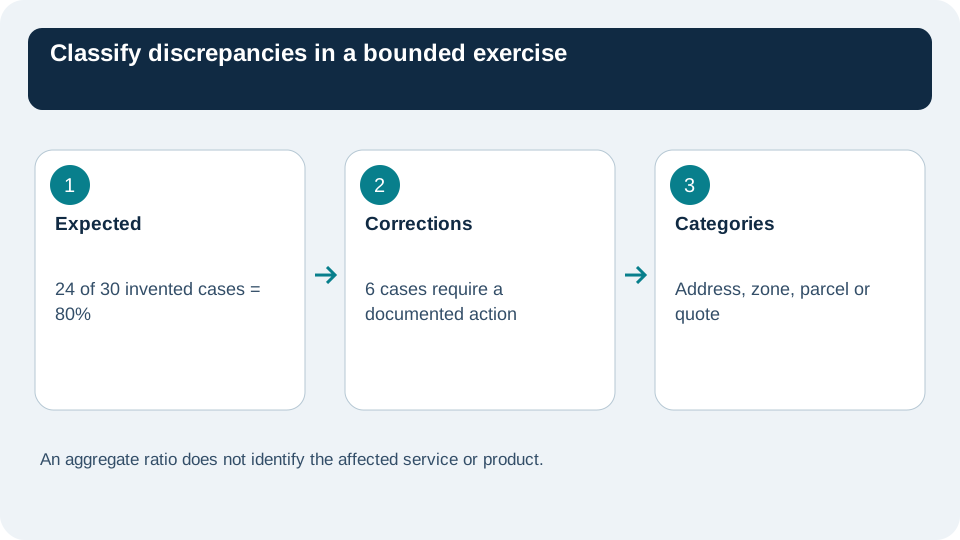
Start with two products and five representative address cases, then vary the quantities. Review the quote, selected method and order handover for each relevant combination. This bounded process builds a delivery zone from actual service conditions, while avoiding unsupported claims based on a ZIP code or straight-line distance alone.