
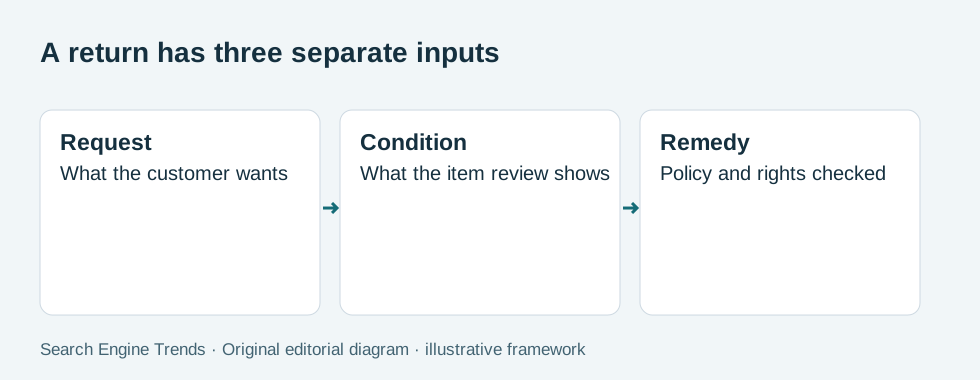
Choose a return workflow by separating the customer’s request, the item’s condition and the applicable policy or rights. Offer exchanges transparently, reserve replacement stock only when appropriate, and reconcile refunds with the original order rather than treating every returned item as sellable.
In this article
Portland ecommerce returns need a clear route from the customer’s first message to a recorded outcome. A request for another size, a reported defect and an incorrect item are different cases. Establish what happened, check the applicable policy and rights, and communicate the available remedy without pushing an exchange merely to protect revenue.
Separate the reason from the item’s condition
For a hypothetical Portland apparel shop, an intact shirt that does not fit may be suitable for an exchange under the store’s applicable policy. A shirt with a reported manufacturing defect requires investigation and an appropriate remedy. Do not apply a standard resale inspection as though it settles every customer’s entitlement.
Ask for the order reference and a short reason. Request photographs only when they help resolve the specific issue, and avoid collecting unrelated personal information. Tell the customer where to send the item, what happens next and who pays transport under the applicable arrangement.
This article describes operations, not a universal US returns rule. Check product-specific, state and federal requirements before publishing policy terms. The FTC merchandise-order rule is relevant to shipping claims, but it should not be misrepresented as a general change-of-mind returns policy.
Build a decision record before moving stock
Keep requested outcome, received condition and final decision in separate fields. An exchange can require new stock allocation before the original item is inspected. Define how long that allocation lasts and what happens if the replacement becomes unavailable.
Request classification
Is this a fit change, a defect or an incorrect item? Record the customer’s words and requested outcome before choosing the workflow. Use product and order evidence to distinguish cases without assuming the answer.
Check against a classified request linked to the original order. If the chosen workflow ignores a reported defect, review the affected case before continuing. The reason identifies the investigation needed; it does not replace checking the applicable remedy.
Exchange allocation
Can the store actually supply the requested replacement? Check available stock for the exact size and color. Define the reservation period and communicate alternatives if the replacement cannot be supplied.
Check against a replacement allocation and customer-approved next action. If the replacement is unavailable or reserved stock expires, review the affected case before continuing. An exchange promise creates a second fulfillment commitment that needs its own capacity and inventory evidence.
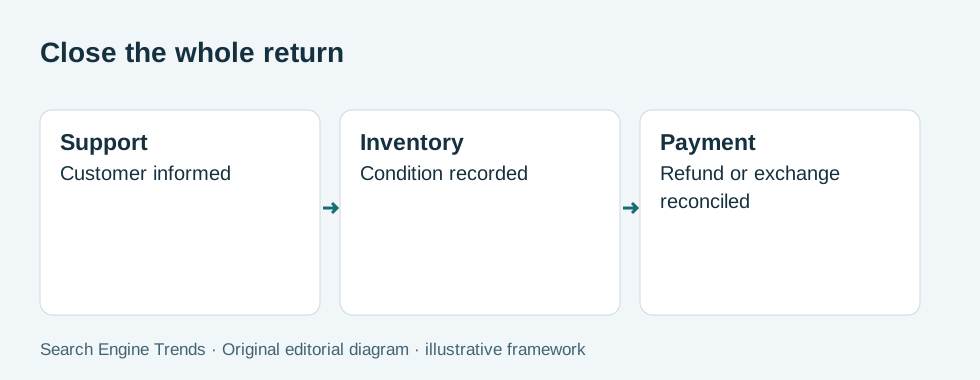
Closing reconciliation
Did inventory and payment both reach the correct state? Inspect the returned garment, set its stock state and reconcile the refund or replacement with the order. Preserve the defect record for product review.
Check against a completed stock and payment record. If support closes the case while the refund or stock update remains pending, review the affected case before continuing. A closed conversation cannot substitute for completing the underlying financial and inventory work.
Compare two hypothetical clothing cases
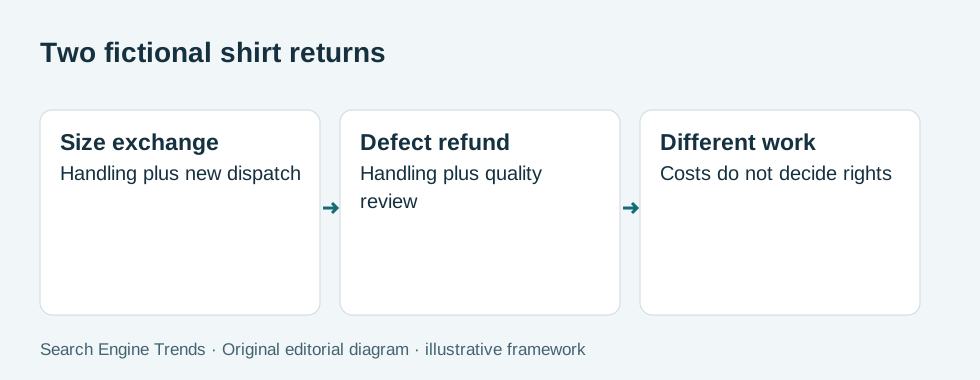
Consider two fictional requests for a USD 60 shirt. Case A involves an intact item and a requested size exchange. Case B involves a reported seam defect and a requested refund. The planning figures below are invented operating costs, not local tariffs or estimates of legal entitlement.
| Illustrative case | Return handling | Additional dispatch | Operational issue |
|---|---|---|---|
| A: size exchange | USD 6 | USD 8 | Replacement stock needed |
| B: defect and refund | USD 6 | None | Quarantine and quality review |
Case A consumes USD 14 in handling and new dispatch before any other cost. Case B has no replacement dispatch, but it requires accurate refund reconciliation and a defect investigation. This arithmetic helps plan the workflow; it does not decide which remedy the customer must accept.
Keep refunds, inventory and quality linked
When goods arrive, identify the order and inspect the specific item. Record whether it can return to available stock, requires repair review or must remain unavailable. Shopify explains these distinctions in its inventory-state guide. Receipt into the warehouse should not automatically make a defective garment sellable.
Reconcile the amount actually refunded, any permitted shipping treatment and the payment status. Explain the processor-dependent timing using the information your payment provider supplies. Do not describe a queued refund as money already visible in the customer’s account.
Tag repeat issues by SKU and reason. A run of size exchanges can indicate unclear fit guidance; repeated seam complaints can indicate a quality problem. The action should address that source, rather than merely making the return portal faster while the same problem continues.
Review the customer message alongside the remedy
For the fictional size exchange, the support reply should identify the replacement size, its availability and the next step for the original item. If the store has not reserved the replacement, avoid wording that presents the exchange as already arranged. A customer may act on that message before the warehouse sees the case.
For the reported seam defect, acknowledge the issue and explain the applicable review and remedy process. Do not send an ordinary fit-change template that implies the customer selected the wrong item. Keep any photograph request proportionate to the issue and explain why it helps.
When a refund is initiated, distinguish the store's processing action from the payment provider's completion. Give the customer the actual amount and the reference they can use if follow-up is needed. These details make the remedy understandable without promising a universal banking timeline. A finished case should have an accurate customer explanation as well as reconciled payment and inventory records; otherwise the team may have completed its internal work while leaving the buyer uncertain.
Returns checklist for the support team
- Record what the customer wants and what they report.
- Check the applicable policy and mandatory rights before offering remedies.
- Explain transport responsibility and the next step clearly.
- Reserve exchange stock through a defined process.
- Inspect received goods before returning them to available inventory.
- Reconcile the actual refund or replacement against the order.
- Escalate repeat defects and unclear sizing to their owners.
Review unresolved returns daily during a busy period. The practical deliverable is a case record that another colleague can finish, including the customer message, stock decision and payment action. Avoid counting a case as successful simply because support closed the conversation.
FAQ
Is an exchange always better for the business?
No. It adds handling and dispatch work and can disappoint the customer if replacement stock is uncertain. Offer it as an appropriate choice, not an automatic revenue-preservation tactic.
Can a returned item go straight back into stock?
Only after the required identification and condition checks. A parcel received in the warehouse is not necessarily a sellable unit.
Which measure shows whether returns are improving?
Track reason-specific resolution time, repeat contact and repeat problems by SKU. A lower refund amount alone does not establish a better customer experience.