Treat AI product copy as a draft assembled from approved evidence. Verify every attribute against the exact SKU, block unsupported compatibility or certification claims, and keep unknown fields unresolved until a responsible reviewer obtains a reliable source.
In this article
AI product descriptions should be generated from a verified attribute record, not from a photograph and a product name alone. A fluent description can quietly invent material, compatibility or included accessories. Require evidence for every buying-critical claim and make missing information a publication decision rather than a creative writing prompt.
This method follows the product’s evidence record. For another language or market, review units, technical translations and applicable documents without expanding the described properties. A documented material is one fact; a new compliance or compatibility statement needs its own support.
Define what the model is allowed to say
For a hypothetical seller of technical accessories, separate source facts from editorial wording. Source facts include the exact connector, dimensions, supplied parts and supported devices. Editorial wording explains those facts clearly. The model can improve a sentence without being authorised to add a new performance claim.
Create a field register with approved, unresolved and conflicting states. An unresolved connector specification should remain unresolved even when the product resembles a familiar accessory. A conflicting supplier sheet needs investigation; averaging two incompatible measurements produces a third unsupported value.
Google’s guidance on generative AI content emphasises accuracy, quality and relevance. The evidence workflow here is an editorial method, not a claim that Google certifies individual AI descriptions.
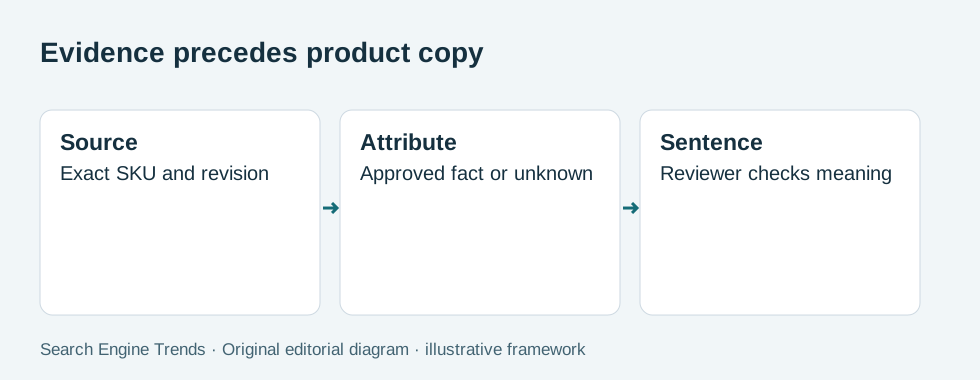
Review the attribute, the source and the sentence
Save the supplier reference, document revision and relevant field with the product record. Ask the drafting tool to use only those facts, preserve limitations and flag missing values. A reviewer then compares each generated claim with the evidence instead of approving the overall tone.
SKU evidence
Does the document describe this exact accessory? Match model references before extracting fields. Keep the document revision with the attribute record and distinguish standard parts from optional configurations.
Check against the exact model and source mapping. If the reference points to a similar model, review the affected case before continuing. A correct fact attached to the wrong product becomes an incorrect customer promise.
Missing attributes
Which claims lack product-specific support? Require explicit unknown states for materials, included parts and compatibility. Prevent the drafting prompt from completing these fields from category conventions.
Check against a marked unresolved-field list. If the draft fills a missing field with an assumed specification, review the affected case before continuing. Unknown values should trigger research, not confident prose.
Final wording
Did the generated sentence preserve the limitation? Compare qualifiers and numbers line by line. Check for added weather, safety and universal-compatibility claims before approving the description.
Check against a claim-level review record. If a qualifier disappears or a new claim appears, review the affected case before continuing. The greatest meaning changes are often a few confident words inside otherwise accurate text.
Use a hypothetical technical-accessory matrix
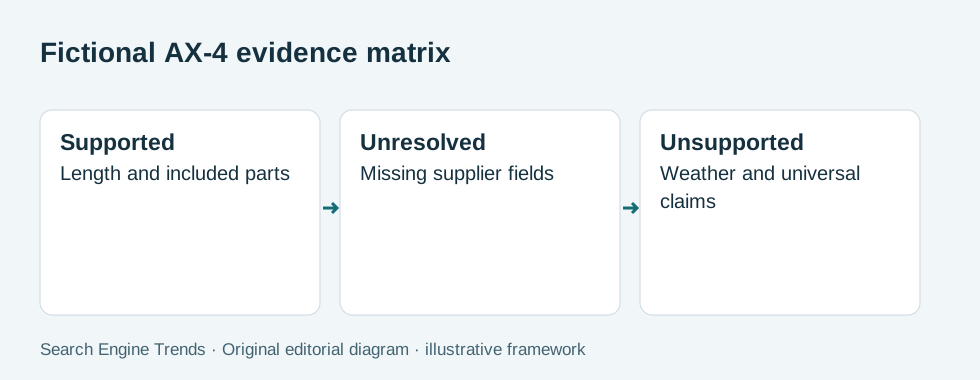
Imagine a fictional desktop adapter named AX-4. The following attributes are invented solely to demonstrate review. The seller has a dimension drawing and a parts list, but no verified weather-resistance or universal-compatibility evidence.
| Attribute | Hypothetical evidence | Publishing decision |
|---|---|---|
| Length: 120 mm | Drawing revision 2 | Publish with units |
| Included cable | Approved parts list | Describe the listed cable |
| Weather resistance | No supporting document | Block the claim |
| Works with every laptop | No compatibility matrix | Block the claim |
“Weather resistant” cannot be inferred from a metal-looking enclosure. “Universal” cannot be inferred from a common connector. Where compatibility is limited, name the verified scope and any required conditions. If those details are unknown, give a support route rather than suggesting that an exchange policy compensates for inaccurate copy.
Test contradictions across the buying journey
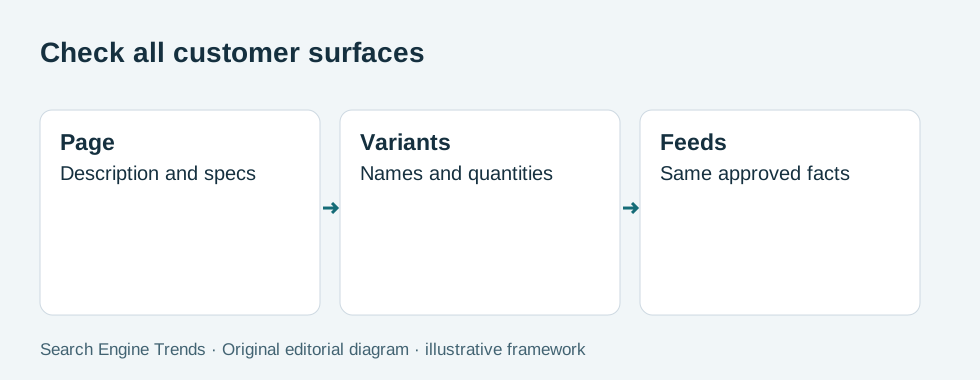
Review the description, specification table, image annotations and variant labels together. An approved description can still conflict with a subtitle inserted by another tool. Check structured data and shopping feeds against the same product record, so unpublished assumptions do not reach search engines through a secondary channel.
Use numerical and qualifier checks: dimensions, quantity, voltage where relevant, materials, “up to”, “not included” and “requires”. A short dropped qualifier can change the buyer’s understanding more than an obviously awkward translation. Track errors by attribute type to identify which source fields need clearer structure.
Do not describe this process as product certification or a safety test. It establishes traceability for published information. Regulated or safety-sensitive claims still require the appropriate documentation and responsible specialist review.
Turn one unsupported claim into a useful review task
Suppose the draft calls the fictional AX-4 adapter “waterproof” even though the evidence packet contains only a dimension drawing. Mark that sentence as blocked and identify the source needed to substantiate such a claim. Do not merely replace “waterproof” with “water resistant”: the weaker wording still describes a property that has not been verified.
The task should distinguish obtaining evidence from revising copy. If a supplier provides an applicable document, the reviewer must check the exact model and the conditions attached to it. If no evidence is available, remove the claim and retain the useful supported details. The product can still have a clear description without a weather-resistance promise.
Apply the same logic to included accessories. A photograph containing a cable does not establish that the cable is supplied. Compare the parts list, packing specification and approved product image. Where they disagree, resolve the product record before regenerating text. This prevents successive drafts from reproducing the same undocumented assumption in increasingly persuasive language.
Publication checklist for generated product copy
- Match every source to the exact SKU and revision.
- Separate approved facts from unknown or conflicting fields.
- Preserve units, exclusions and compatibility conditions.
- Remove unsupported superlatives, certifications and performance claims.
- Compare page copy with variant labels and feeds.
- Save reviewer decisions and the next review trigger.
Start with a small product batch and inspect every description. Expansion is justified when the evidence structure is dependable, not merely when the tool produces text quickly. A DIY product-copy workbook should help readers maintain this record rather than encourage one-click mass publication.
FAQ
Can AI infer a material from a photograph?
It can suggest an interpretation, but that is not adequate proof for a published product attribute. Obtain supplier documentation or another reliable product-specific record.
Should unknown fields be filled with common values?
No. A common value for the category may still be wrong for the item. Leave the field unresolved and assign someone to obtain evidence.
What should a reviewer approve?
Approve the individual claims, their source links and the final customer-facing wording. An overall impression that the description sounds credible is insufficient.
GEO: Understand and Act
Explore this related DIY Marketing Guide guide to work further on the method. DIY is part of our business group; contents, language and price are shown on its store.
See the English guide