
Give an AI drafting tool an evidence packet before asking it for persuasive copy. Separate verified facts, hypotheses and missing information, then check numbers, product features, testimonials, outcomes and location claims individually before publication.
In this article
Evidence for AI-written content should be assembled before the draft begins. A small agency can use AI to organise an explanation, but the tool cannot create the client experience or measurements needed to support a claim. Give it approved facts, identify missing information and require hypothetical scenarios to remain visibly hypothetical.
The review follows the article’s evidence wherever the agency works. An office location, service area or client experience must come from real records. The GBP amount remains a worksheet assumption and supports no conclusion about local fees or results.
Build the evidence packet around the buying question
For a hypothetical agency serving shop owners, a brief about product-page improvements should identify the reader’s problem, the exact page task and the source material available. Include product documents, current feature documentation and the client’s own approved records where relevant.
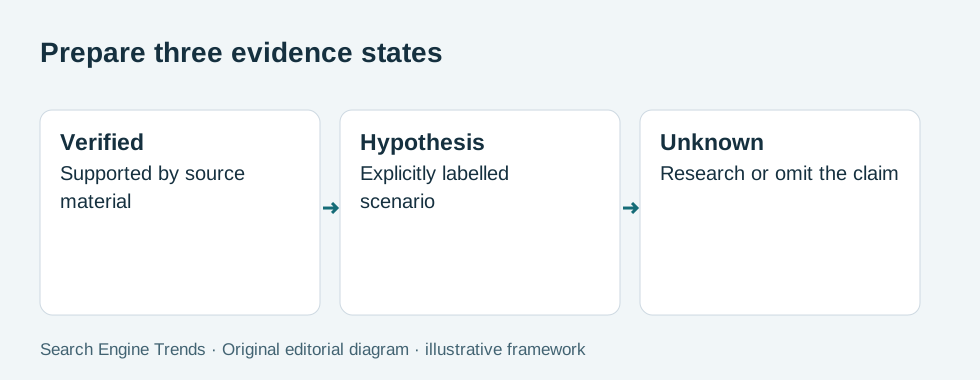
Put the evidence into three groups: verified facts, hypotheses for discussion and unknowns. “The product includes two replacement pads” belongs in verified facts only when the supplied-item record supports it. “A clearer contents table may reduce questions” is a hypothesis. “The store’s customers prefer this layout” remains unknown without suitable evidence.
Google’s people-first content guidance offers a quality review framework. An original article still needs its own useful method and examples; repeating a search engine’s guidance cannot substitute for answering the reader’s practical question.
Review five claim types separately
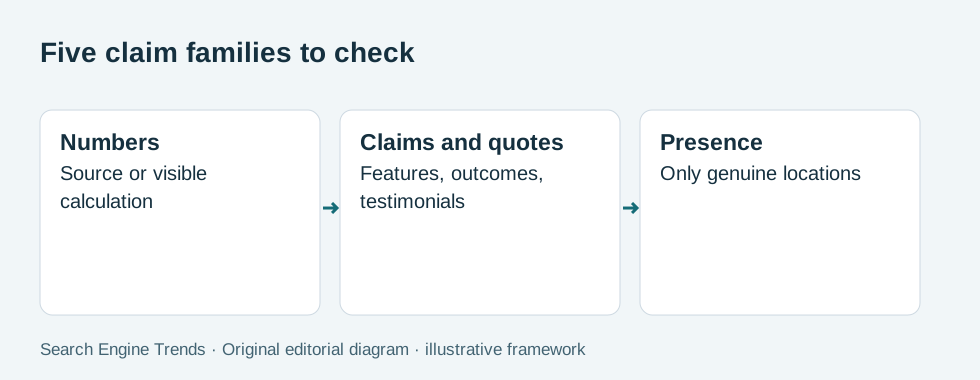
Numbers need a source, calculation or explicit hypothetical label. Product features need current product-specific evidence. Outcome claims need a comparable measurement, not a screenshot showing activity. Testimonials need a genuine statement and appropriate permission to use it. Location claims need an actual business presence or a truthful description of the audience served.
| Illustrative draft claim | Evidence needed | Decision without evidence |
|---|---|---|
| The budget is GBP 300 | Stated assumption or real record | Label the scenario |
| Sales increased | Comparable outcome measurement | Remove the result claim |
| The tool offers this option | Current official documentation | Verify or omit |
| A client said these words | Genuine approved quotation | Remove the quotation |
| Our office is in this city | Real location evidence | Do not invent a presence |
The GBP 300 amount is hypothetical and not an agency fee benchmark. A number becomes useful when the reader can see what it assumes, how it is calculated and what decision it supports.
Write the prompt so unknowns stay unknown
Ask the drafting tool to use only the supplied evidence for factual claims, preserve limitations and flag missing values. Give it permission to improve explanation and structure without adding unsupported capabilities. A rule to “make the article convincing” should never override the fact boundaries in the brief.
Specify the treatment of examples. A fictional shop can illustrate a workflow if the article calls it fictional. It should not acquire a named owner, a customer quotation or a measured sales improvement merely because those details make the story vivid. Originality can come from the analysis and worksheet, not invented experience.
Request source links beside the claims they support. Then open those links during review. A plausible-looking address is not evidence that a page exists, and an existing page may discuss a different tool version or product scope.
Use separate meaning and readability reviews
First, inspect meaning. Check every number, comparison, quotation, feature and statement of experience against the evidence packet. Look for qualifier changes: “can”, “requires”, “not included” and “under these conditions” can materially change a promise. The reviewer should identify which sentence needs correction and why.
Second, inspect usefulness and language. Does the opening answer the actual question? Can the reader follow the method? Does the example show the calculation or decision? Remove paragraphs that simply repeat the heading with more adjectives. An accurate but vague draft still fails to help someone act.
If a correction changes the source facts, update the brief before regenerating the paragraph. Otherwise the next draft may reproduce the same error. Keep the approved wording and the supporting record linked so a later editor can distinguish a deliberate limitation from an accidental omission.
A hypothetical claim review
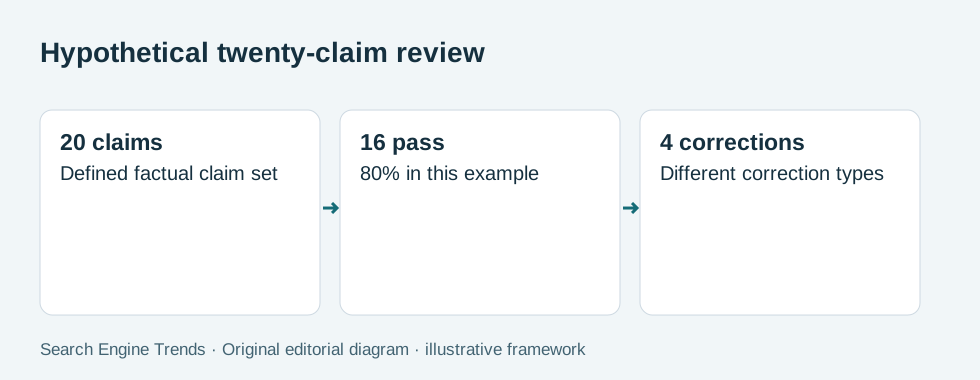
Suppose a draft contains twenty factual claims. Two have no source, one changes an official feature’s scope and one describes a fictional example as a real client outcome. Sixteen claims pass the defined review, giving an illustrative claim-level pass rate of 80%. That figure measures this invented review, not the reliability of a model generally.
The four failed claims need different corrections. An unsupported feature needs documentation or removal. A falsely presented outcome needs its hypothetical label and rewritten framing. Counting all four as “minor wording issues” would conceal the publication risk.
Keep an acceptance checklist for the final page
- Verify facts against the exact product or feature scope.
- Recalculate figures and label assumptions.
- Remove invented experience, reviews and quotations.
- Keep missing facts unresolved until evidence arrives.
- Check each cited page and the claim it supports.
- Review the final rendered page, including captions and callouts.
The rendered check matters because a correct main article can coexist with an exaggerated summary or a stale image caption. Review all customer-facing surfaces with the same evidence rules. Increase production volume only after the source and review process can keep pace.
Check captions and summaries with the same rules
A careful main article can still carry an unsupported promise in its headline, answer box or diagram caption. Review these shorter elements as separate claims. If the body explains a hypothetical GBP 300 budget, the summary should not call it the price agencies charge. If a diagram illustrates a process, its caption should not describe it as a completed client test.
Compare the final page with the approved source brief after formatting. Numbers can be changed during design, links can point to an older source and a quotation can lose the context identifying it as illustrative. Treat these as editorial corrections before release. The acceptance record should identify the actual page reviewed, so later revisions do not inherit approval for wording that has since changed.
FAQ
Can an AI draft use fictional examples?
Yes, when they are explicitly identified and illustrate the method honestly. Do not frame them as client results or attach fabricated testimonials.
Is a citation enough to approve a claim?
No. The source must exist, be appropriate and support the exact statement. A linked page about a product family may not substantiate a model-specific capability.
Should every draft be reviewed sentence by sentence?
Review buying-critical and factual claims individually. The depth of review should follow the consequences of an error, with greater care for safety, legal or financial statements.
SEO Writing and Conversion
Explore this related DIY Marketing Guide guide to work further on the method. DIY is part of our business group; contents, language and price are shown on its store.
See the English guide