
Use one stable SKU for each sellable variant, with separate supplier and barcode mappings. Keep physical stock distinct from available, committed and unavailable units, and inspect imports, cancellations and transfers before relying on the customer-facing quantity.

In this article
Identify the sellable variant before counting units
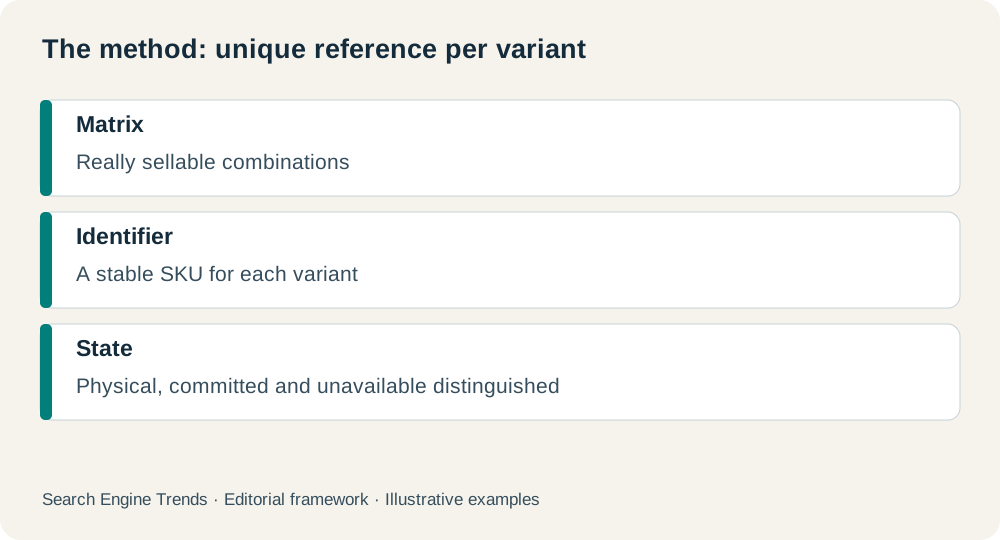
A unique SKU per variant makes it possible to link stock, order, image and preparation without ambiguity. For a store in Winnipeg, build the size and colour matrix before importing inventory. Two different sellable variants should not accidentally share the same stock identifier.
The product’s customer-facing name may change, while its reference must maintain a stable relationship with the actual item. A colour renamed “slate” must not cause the connection with historical stock movements to be lost. Keep the visible label and the identifier used in operational records separate.
The examples are hypothetical and do not describe any local inventory. The CAD currency may appear in your pricing file, but it does not have to be included in the SKU. Price, location and stock change; the identifier is used to recognize the variant despite these changes.
Draw a matrix without imaginary combinations
List the sizes and colours actually produced, then mark the existing combinations. Three colours and four sizes can result in twelve variations, but only if all combinations are actually offered. A theoretical matrix should not create items that your supplier does not deliver.
Choose a short and stable format, with documented codes. For example, a family, a colour and a size can make up the reference. Avoid characters that your import tools or scanners process poorly; test the format on the relevant store, point-of-sale system and logistics system.
Shopify distinguishes between several inventory states, including available, committed and unavailable. This distinction complements variant identification: knowing which item exists is not enough to know how many can be sold. Consult the definition of each state in your configuration before reconciling the exports.
An illustrative clothing matrix
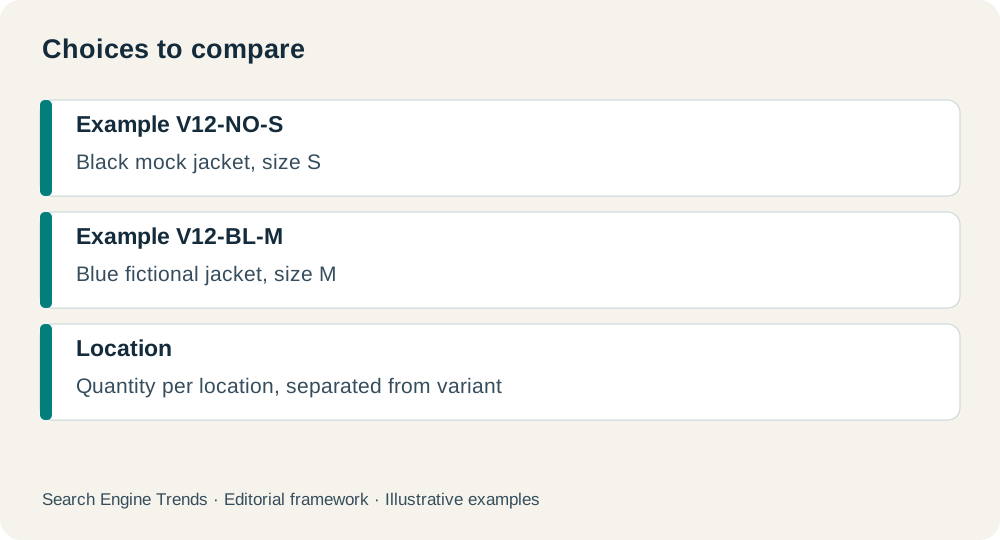
Let's imagine a hypothetical jacket with two colours, black and blue, and three sizes S, M and L. These six fictional variants are given six distinct references, for example V12-BK-S and V12-BL-M. These codes are educational examples; they do not match any item in your catalog.
| Fictional variant | Illustrative SKU | Control |
|---|---|---|
| Black, S | V12-BK-S | One row and one item |
| Black, M | V12-BK-M | Correct image association |
| Black, L | V12-BK-L | Size transmitted to picking |
| Blue, S | V12-BL-S | Correct colour passed to picking |
| Blue, M | V12-BL-M | No duplicate references |
| Blue, L | V12-BL-L | Supplier reference mapping |
A barcode and a SKU do not necessarily play the same role. Keep their relationship in separate columns when they exist. Do not replace a supplier reference with an internal code without keeping the supplier mapping used at receiving.
Separate physical stock and sellable stock
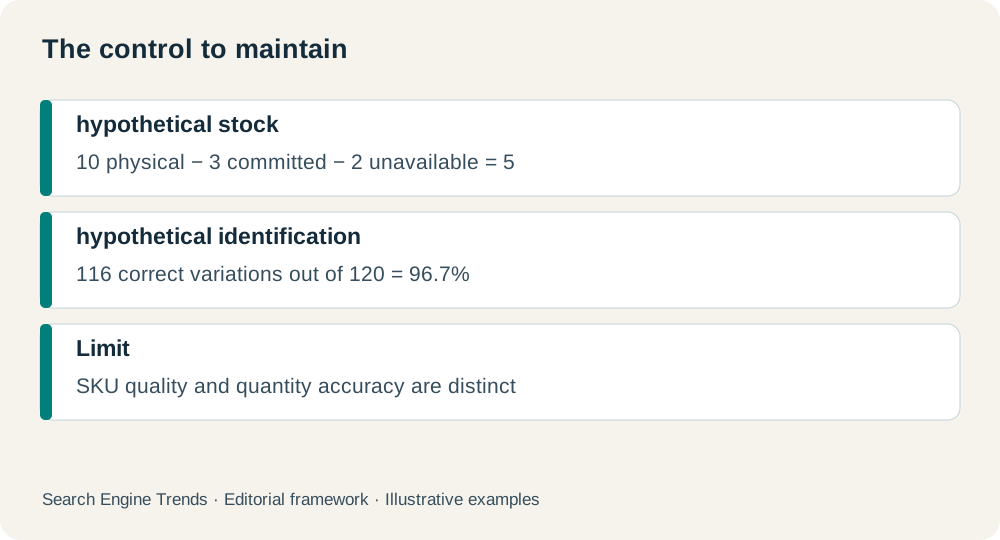
Let's assume ten physical units of a variant, three of which are reserved for orders and two of which are unavailable after inspection. In our simplified illustrative convention, five remain sellable. Showing ten because the physical count is accurate would cause potential overselling.
Record the events and categories behind each inventory state: order commitment, damage, inspection, transfer and expected arrival. A unit announced by a supplier is not yet a unit received. A transfer between locations can move availability without changing the overall total; sales must follow the right location.
Also check the cancellation. An order deleted from the commercial table must not leave an active reservation without reason, nor release an item that has already left. Inventory changes must follow the actual order status. An invisible manual note in the export greatly complicates this reconciliation.
Secure imports and modifications
Before an import, save the relevant existing records and check for duplicate rows, missing columns and unexpected values. Test a small batch of representative references. The file should distinguish between a quantity correction and a variant creation, according to the tool’s import rules.
Prepare a code dictionary that remains accessible to receiving and picking staff. This document indicates the meaning of abbreviations, authorized formats and old references replaced. Don't assume that a code understood by its creator will be clear to a new colleague. If two colours have similar initials, check that staff can distinguish them on a printed label. A distinction visible on a large screen can disappear on a small picking slip or on a low-contrast printout.
Decide who can change identifiers and document the procedure. A SKU replacement may break a provider's product mappings or historical analytics. When the item actually changes, create an explicit replacement relationship and check the old documents; don't just recycle the code for a different product.
Upon receipt, reconcile the supplier reference, internal SKU and physical item. An initial error can propagate to images, prices and orders. Run receiving checks before making stock available, with a clear outcome for unrecognized references.
Measure deviations at the SKU level
Track detected duplicates, mismatched lines, picking corrections, and inventory discrepancies by SKU. An overall average can mask a variant that is systematically confused with another. First look at errors that repeat on the same code or combination.
In a hypothetical scenario of 120 variants, four have a duplicate or missing reference. The correctly identified share is worth 116 ÷ 120, or 96.7%. This ratio does not prove the accuracy of the quantities; it only measures the quality of identification according to the control carried out.
To begin, choose a family, construct its matrix, and check each relationship with physical stock. Then place a hypothetical order representing two similar variants. If the preparer finds colour and size unambiguously, you have verified an essential part of the process, before extending the system to the rest of the catalog.
SKU and availability checklist
- Confirm each sellable size-and-colour combination has one identifier.
- Keep supplier reference and barcode mappings in separate fields.
- Review duplicate codes before an inventory import.
- Check quantities at the actual fulfilment location.
- Separate available, committed, unavailable and incoming units.
- Inspect one cancellation and one transfer for correct state changes.
Do not reuse a retired identifier for an unrelated item. Historical orders and warehouse documents may still refer to the old SKU. Keep an explicit replacement relationship where a product changes, so a later stock review can explain which physical item each record represented.
FAQs on SKUs and quantities
Can we use the product name as a reference?
A name can change and lack precision. Use a stable ID associated with the variant, then keep the commercial label in a separate field.
Do two stock locations require two SKUs?
Location generally describes where the variant is located, not another variant. However, check your tool requirements and keep the quantity per location.
Why does physical stock differ from available stock?
Reservations and unavailable units may explain the discrepancy. Reconcile the states and their movements rather than changing available stock to make it identical to the physical count.
Official reference consulted: Shopify: definition of inventory states. The scenarios and calculations are hypothetical editorial examples, not measured results from a local business.