
Compare third-party fulfilment offers against one shared operating profile. Include receiving, storage, picking, packaging, returns, minimums and exceptions, then assess service evidence separately from price. Use supplier quotes in a transparent model rather than ranking providers by advertised fees.

In this article
An Atlanta 3PL quote comparison needs a shared order profile before it needs a shortlist. Give each provider the same SKU count, inbound pattern, order volume, basket mix and destination sample. Compare the full monthly invoice and the promised operating process, not just the advertised price of one pick.
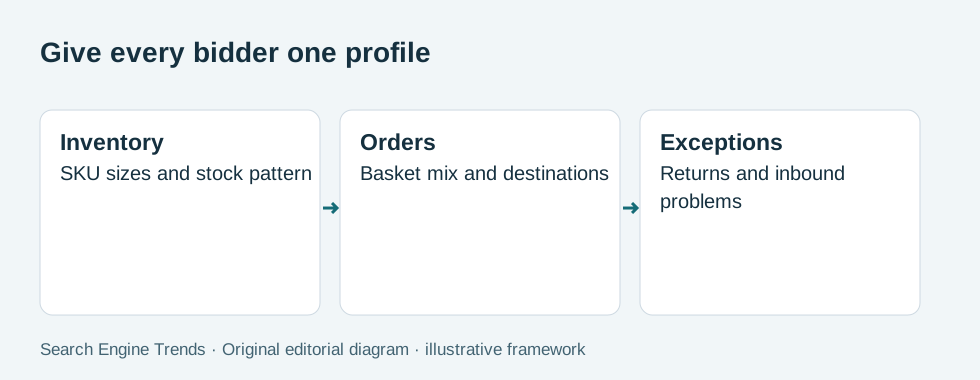
Describe the business the warehouse will serve
A hypothetical Atlanta merchant has 80 active SKUs and a mixture of single-item and three-item orders. Its supplier deliveries arrive in cartons with variable labelling quality. Those details affect receiving, storage and exception work, so include them in the request rather than waiting for an onboarding invoice.
List product dimensions, handling restrictions, seasonal peaks and expected returns. State which volumes are observed and which are forecasts. Avoid presenting a forecast peak as a guaranteed purchasing commitment. Ask how the quote changes if actual volume is lower or the product mix becomes more complex.
Shopify’s inventory-state documentation is useful for defining stock states to reconcile with a warehouse system. Agree what “available” means on both sides before connecting orders.
Require a common commercial and service response
Provide a worksheet instead of three differently formatted sales decks. Ask providers to identify included work, chargeable exceptions, volume minimums and the event that starts each service clock. A commitment to same-day dispatch needs a cutoff, inventory availability rule and exception process to be reviewable.
Shared workload
What basket and inventory profile is every provider pricing? Send the same order sample, SKU dimensions and inbound assumptions to all bidders. Distinguish known operations from forecast volume.
Check against one versioned operating brief. If a bid prices a different basket mix or storage requirement, review the affected case before continuing. A common brief exposes commercial differences that a comparison of unrelated headline fees cannot reveal.
Invoice scope
Which work is included and which work creates an extra charge? Require receiving, storage, order handling, additional picks, packaging, returns and minimum charges as explicit lines. Ask for exception examples.
Check against a complete priced scope with exclusions. If an important operation has no stated charging basis, review the affected case before continuing. Hidden scope usually becomes visible during onboarding or the first busy month, when switching is harder.
Service evidence
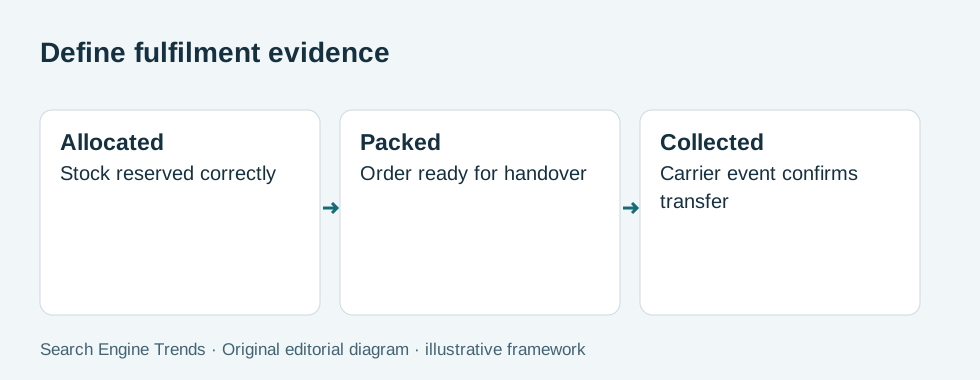
Which event proves that the promised action occurred? Agree timestamps for receipt, allocation and carrier handover. Test one stock discrepancy and one failed fulfillment case before increasing volume.
Check against an event map and exception escalation record. If a shipping label is treated as proof of carrier collection, review the affected case before continuing. The service definition must describe observable work rather than a convenient status label.
Calculate a hypothetical monthly comparison
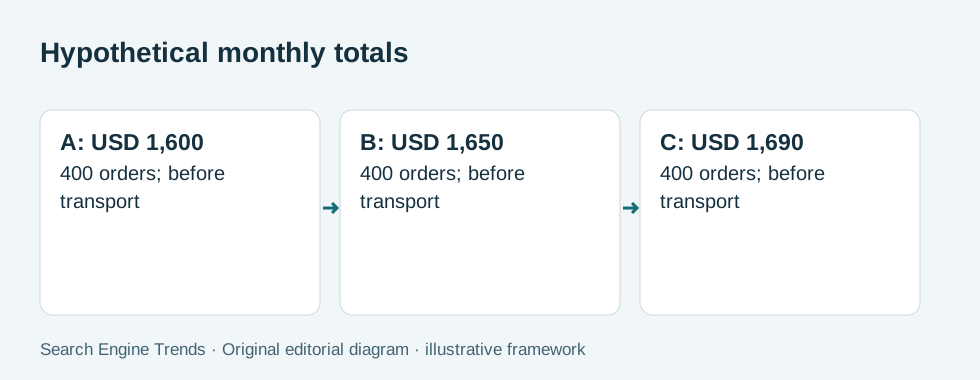
Suppose the planning case contains 400 orders: 250 single-item baskets and 150 three-item baskets. That is 700 units picked, not 400. The worksheet below uses fictional cost totals only to demonstrate arithmetic; A, B and C do not represent actual providers or Atlanta market prices.
| Illustrative monthly line | A: USD | B: USD | C: USD |
|---|---|---|---|
| Receiving and storage | 500 | 650 | 450 |
| Order handling and picks | 900 | 760 | 980 |
| Packaging and exceptions | 200 | 240 | 260 |
| Total before transport | 1,600 | 1,650 | 1,690 |
The hypothetical cost per order is USD 4.00, USD 4.125 and USD 4.225 respectively, before transport and other excluded items. Small differences can reverse when a minimum charge, returns workload or storage ageing fee is included. Ask each supplier to validate every line using its actual proposal.
Test the service separately from the price
Define when an order is received, allocated, picked, handed to a carrier and reconciled back to the store. A label-created timestamp is not proof of carrier collection. Specify the evidence each system will exchange and how the team will respond when a fulfillment event is missing.
Ask for an onboarding sample that includes an inventory discrepancy, an address exception and a return. These cases reveal more than a flawless demonstration order. Confirm who resolves stock disagreements and how damaged inbound goods are recorded before they become sellable stock.
Assess the exit process too: stock export, remaining inventory release, account data and outstanding invoices. A low monthly fee is less attractive if the business cannot retrieve reliable records or recover inventory through a defined handover.
Stress-test the quote at a lower volume
Ask each bidder to price a month with two hundred orders as well as the hypothetical four-hundred-order case. Keep the SKU count and stated storage requirement visible instead of halving every line automatically. Storage can remain similar while handling volume falls, and a minimum monthly charge can become more important.
Request one illustrative exception invoice based on the supplier's actual charging rules: an inbound carton with missing labels, an order with an extra item, and a returned product requiring inspection. The provider should identify how each case is billed and who approves additional work. This is a scope check, not a request to invent favourable rates.
Finally, compare the service response at peak volume. Establish what happens when orders exceed the quoted daily capacity and whether the customer promise must change. A proposal that handles an average month well can still be unsuitable for a concentrated campaign. Record the merchant's responsibilities, such as sending advance forecasts or properly labelled inbound goods, beside the warehouse commitments.
Checklist before choosing a fulfillment partner
- Send one operating profile to every bidder.
- Count order lines, units and storage requirements separately.
- Include minimums, receiving, returns and exceptions.
- Identify transport and packaging exclusions.
- Define service clocks and proof of handover.
- Test inventory reconciliation and an unsuccessful order case.
- Review onboarding and exit responsibilities.
Choose a provider whose quoted scope and process can support the actual catalog. Keep unresolved items visible until the proposal answers them. This is a commercial comparison method, not a supplier ranking or a claim that any provider has been independently tested.
FAQ
Is the cheapest pick fee the best offer?
It is only one line. Receiving, storage, minimum charges, additional units and exception work can change the total substantially.
Should transport be included in the model?
Yes, as a separate reconciled line. Confirm whether the provider’s carrier charges, markups and surcharges are included in the proposal.
What is the first integration check?
Confirm that stock states and order events mean the same thing in both systems. Otherwise technically successful messages can create incorrect availability or premature dispatch notifications.