
Measure subscription retention by a stable cohort and a defined milestone. Separate customers who remain active, customers who receive another completed order and the revenue retained after refunds. Align observation windows before comparing one cohort with another.

In this article
Boston subscription retention is easier to understand when customers stay in the cohort where they began. Follow first, second and third completed orders, then compare accounts and retained revenue separately. An active subscription record is not proof that a customer received the next shipment or paid the next renewal successfully.
Choose the event that starts the cohort
A hypothetical Boston replenishment business might group subscribers by the month of their first completed order. Keep trial registrations outside that group until the defined purchase milestone occurs. State how migrated subscribers, gifts and prepaid plans are handled; they can behave differently from ordinary monthly renewals.
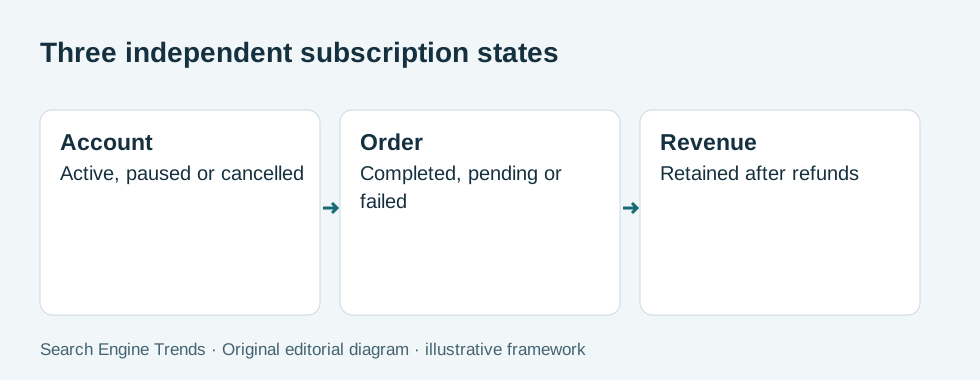
Use the order ledger to identify completed shipments and payment status. Keep pauses, failed payments and cancellations as separate states. Combining them into one churn label hides the action needed: a paused customer may need scheduling flexibility, while a failed payment may require a payment-recovery process.
Shopify’s subscription documentation describes subscriptions as purchase options. Reporting still needs your own definitions for cohort start, order completion and the observation period.
Make the cohort rules repeatable
Document the cohort query or spreadsheet logic before presenting retention figures. Record when the data was extracted and how long each group has been observed. A new cohort cannot be judged at its third-order milestone before enough time has elapsed for those orders to occur.
Cohort membership
Which completed purchase places someone in this cohort? Use one start event and keep membership stable. Identify prepaid, gifted and migrated cases rather than assigning them arbitrarily to the extraction month.
Check against a cohort membership rule and raw customer count. If the same customer moves cohorts between reports, review the affected case before continuing. Stable membership allows the business to compare progress rather than changes in reporting logic.
Milestone eligibility
Has every customer had time to reach this order number? Use plan cadence to establish the observation window. Mark immature cohorts as pending rather than recording their unobserved future orders as losses.
Check against a maturity flag for each cohort milestone. If a quarterly plan is compared with a fully matured monthly group, review the affected case before continuing. Time alignment prevents a young cohort from appearing worse simply because renewal is not due.
Retained value
Which revenue remained after the renewal and refund process? Reconcile completed orders, discounts and refunds. Separate higher spending by remaining buyers from the number of original customers who continue.
Check against a reconciled retained-revenue calculation. If gross renewal charges are reported despite refunds or cancellations, review the affected case before continuing. Account continuation and retained money explain different parts of subscription health.
Calculate three distinct retention measures
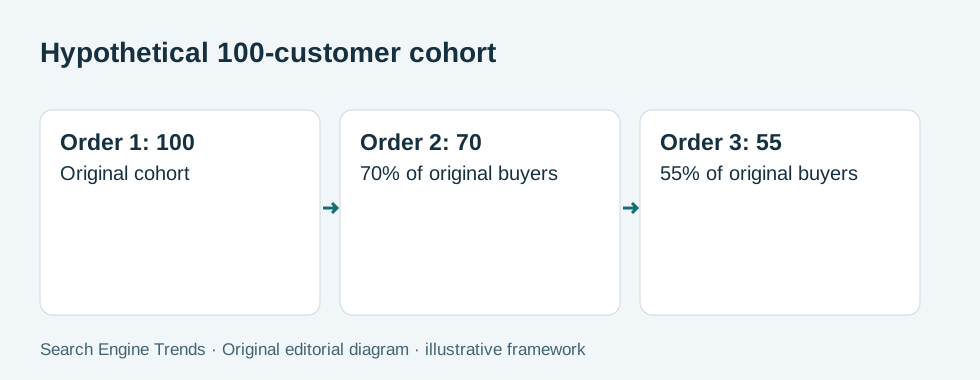
In an explicitly hypothetical cohort, 100 customers complete an initial order. Seventy complete order two, and fifty-five complete order three. Second-order retention is 70%, and third-order retention is 55% of the original cohort. Conditional continuation from order two to three is 55 ÷ 70, or approximately 78.6%. Label that denominator clearly.
| Hypothetical milestone | Customers | Share of original cohort |
|---|---|---|
| First completed order | 100 | 100% |
| Second completed order | 70 | 70% |
| Third completed order | 55 | 55% |
Now suppose the third-order buyers purchase larger boxes. Revenue retention can exceed customer retention without more customers remaining. Conversely, discounts or partial refunds can reduce retained revenue even when the account count is stable. Present both measures rather than choosing whichever looks stronger.
Investigate the point where continuation falls
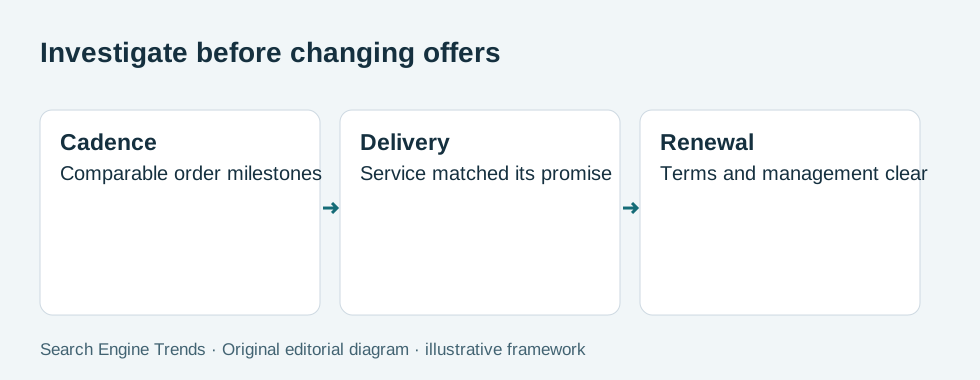
Read operational records around the first-to-second-order gap. Did the initial delivery meet the stated window? Were product quantities appropriate? Was the renewal explained clearly? Were customers given the scheduling and management options actually available in the subscription system?
Compare reasons within equivalent cohorts rather than attributing all differences to a marketing change. Product mix, acquisition source and plan cadence can change the comparison. A weekly plan reaches three orders earlier than a quarterly plan; matching calendar age alone does not align their buying milestones.
Create a simple review of account status, order status and financial status. Google’s ecommerce event guide supports purchase and refund measurement, but analytics events should be reconciled with the subscription and commerce records before being treated as retained revenue.
Explain the denominator before presenting a percentage
For the fictional cohort, order-three retention is 55% of the hundred original buyers. The approximately 78.6% continuation figure instead uses the seventy buyers who reached order two. Both calculations are valid for their stated questions. Displaying them together without those labels would suggest two contradictory retention results.
Keep a note for customers who skip a shipment and later resume. Decide whether the milestone means the next scheduled renewal, the next completed order or completion within a defined window. A skipped month does not necessarily mean the customer will never place a third order. The reporting convention should preserve that distinction.
Add a product-mix check to the review. If one cohort began with a discounted trial box and another with the full subscription, their first-order contribution and renewal expectations may differ. Explain that difference before crediting a support message or campaign for the retention gap. The cohort table identifies where to investigate; it does not establish which intervention caused a change.
Cohort-review checklist
- Define first completed order and preserve original cohort membership.
- Identify plan cadence and gift or prepaid cases.
- Align the observation window for the milestone being compared.
- Report active accounts separately from completed orders.
- Deduct refunds consistently from revenue measures.
- Label original-cohort and conditional percentages clearly.
- Assign a concrete action to each major cancellation or failure reason.
Review a small number of comparable cohorts and keep the underlying counts beside percentages. Ten customers and a hundred customers can produce the same rate with very different uncertainty. Use the report to select a service or product improvement, then observe the next equivalent cohort before claiming success.
FAQ
Is an active subscription a retained customer?
It is an account-status measure. For order retention, check whether the defined renewal or shipment completed. Report both when they answer different business questions.
Should paused subscribers count as churn?
Define the measure first and show pauses separately. Treating every pause as cancellation can misdirect product and support decisions.
Can revenue retention exceed customer retention?
Yes, if the remaining buyers spend more. That does not mean customer retention improved, so use clear labels and show the customer count alongside revenue.