
A free shipping threshold must preserve contribution after the costs the seller absorbs. Compare realistic CAD baskets, calculate an illustrative threshold and test discounts, weight and destination exceptions against the same rule used at checkout.

In this article
A profitable threshold is calculated per basket
A free shipping threshold must leave enough contribution after product cost, fulfilment, payment processing and shipping paid by the seller. For a store selling in Canadian dollars, calculate several representative baskets in CAD and test for real exceptions. The average basket size alone does not reveal orders that cost more to ship.
The Canadian context is the example currency, not a national shipping-cost benchmark. For a real basket, record the origin postal code, destination, packed weight, dimensions and requested service before obtaining a quote. Keep those parameters with the cost used in the threshold model.
Free delivery does not remove the cost: it changes who pays it. A larger order can absorb this expense if its composition maintains a sufficient margin. Adding a heavy or heavily discounted product can increase shipping costs without adding enough contribution to cover them.
The following figures are hypothetical and are not carrier rates or industry margin benchmarks. The threshold chosen for your business must be based on your costs and the quotes corresponding to your areas, products and services. Check the configuration in your store before announcing the offer.
Define the calculation base and exclusions
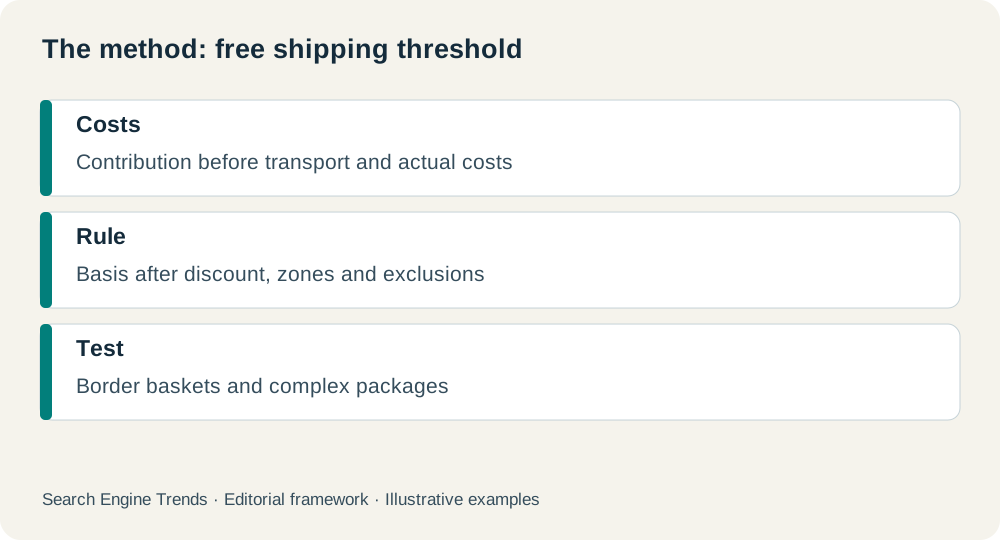
Decide whether the threshold applies to the amount after discounts and to what product scope. State the eligible delivery areas and shipping methods. The customer must find the same rule on the product page, in the basket and at payment, without interpreting a general banner as universal free shipping.
List the categories that require special treatment: heavy package, unusual size, product shipped separately or destination outside the scope. Exceptions must follow actual costs and possibilities, not be created after the order. Prepare visible wording when the cart is not eligible.
Shopify documents condition-based shipping rates and free-shipping options. Verify your exact system settings, including interaction with discounts and shipping profiles. A well-calculated rule can behave unexpectedly when shipping profiles or methods combine differently from your assumptions.
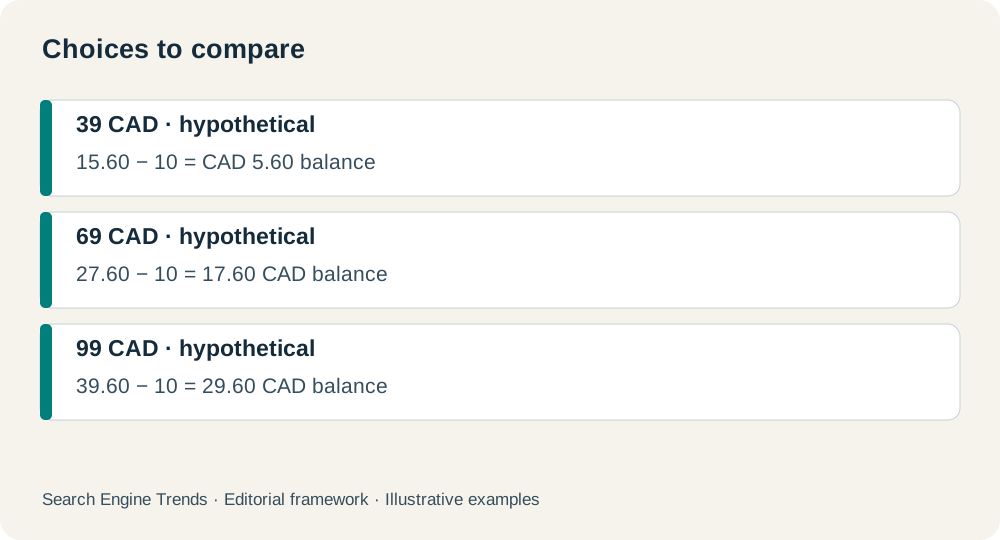
Three hypothetical baskets to compare
Assume a contribution before shipping equal to 40% of net product revenue in a simplified illustration. A seller transportation cost of 10 CAD applies to the three hypothetical baskets of 39, 69 and 99 CAD. The contributions after transport are 5.60, 17.60 and 29.60 CAD. Other fees already included in the 40% must be documented in your actual calculation.
| CAD hypothetical basket | Contribution before transport | Hypothetical shipping cost | Remaining contribution, CAD |
|---|---|---|---|
| 39 | 15.60 | 10 | 5.60 |
| 69 | 27.60 | 10 | 17.60 |
| 99 | 39.60 | 10 | 29.60 |
If the hypothetical store wants to keep 18 CAD after transport, the 69 CAD basket is missing 0.40 CAD in this model. The 99 CAD basket passes this criterion. This reading does not automatically provide the best commercial threshold; it only verifies a defined economic condition.
Calculate the theoretical threshold then test the catalog
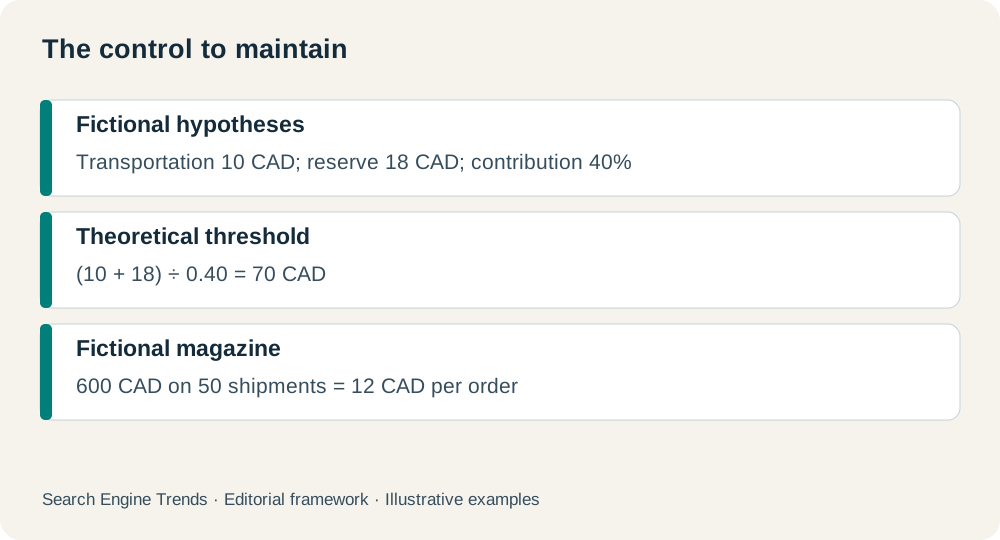
With a proportional contribution of 40%, a fixed cost of 10 CAD and a desired reserve of 18 CAD, the theoretical threshold in the illustration is (10 + 18) ÷ 0.40 = 70 CAD. This is a consequence of the assumptions, not a recommended threshold for every Canadian store.
The actual catalog rarely has an identical contribution for all items. Rebuild common baskets, including a discounted basket and a heavy basket. For each, calculate the effective costs and check whether the threshold leaves the desired reserve. A basket passing the amount but failing the weight criterion requires an additional clear rule.
If costs differ significantly by destination, separate areas where your system and offering allow. Do not publish a blanket free-shipping offer then add an unexpected supplement after the order is placed. The transport price chosen in the basket must correspond to what will actually be invoiced.
Test discounts and boundary cases
Prepare baskets just below, exactly at the threshold and just above. Add a promotional code, an excluded product and multiple quantities of a heavy item. Check the result in a new session, on mobile and desktop through the final order summary.
A discount may lower the eligible amount if your rule uses the revenue after discounts. The message must explain the remaining amount on this same basis. A progress message displaying “still 1 CAD” before a discount but another amount upon payment creates a visible inconsistency.
Also check multi-package baskets and products sent from different points. Your cost may double while the total amount remains above the threshold. The trial must identify these cases before launch. When the system cannot process them properly, limit the offer to baskets whose behavior has been validated.
Measure post-launch contribution
Track eligible orders, actual shipping cost, net contribution, and exception usage. An increase in average order value is a commercial signal, but it does not demonstrate profitability. Buyers can add a low-margin product to reach the threshold.
In a hypothetical series of fifty orders with free shipping, total shipping costs are CAD 600, or 12 CAD per order rather than the 10 CAD expected. Recalculate the baskets with this cost and classify the difference by weight, area or number of packages. A higher average calls for a review of the cost assumption.
To get started, put together ten representative shopping carts and get their shipping costs. Choose a tentative threshold, test the boundaries, and publish a clear rule. Plan a review date and a contribution limit, in order to correct the offer based on observed data rather than waiting for a loss that is difficult to explain.
Free-shipping boundary checklist
- Test CAD 69.99, CAD 70 and CAD 70.01 in the illustrative model.
- Apply the same discount treatment used by the actual checkout.
- Add a heavy item and inspect the quoted service.
- Check a basket requiring more than one package.
- Review an address outside the eligible service area.
- Compare the final order summary with the promotional message.
If the page uses a progress message, it should calculate the remaining amount from the same eligible subtotal as checkout. Do not let an attractive banner announce eligibility while a later screen applies a different product or zone rule.
Free Shipping FAQ
Should you copy a competitor’s threshold?
No. You don't necessarily know its costs, discounts and conditions. Use your own basket combinations and quotes to calculate contribution.
Should the threshold include discounts?
Define the actual rule and display it clearly. The tests must use the same eligible subtotal used at checkout.
Is a weight exception acceptable?
It may correspond to a real constraint, but must be visible before purchase and correctly applied. A surcharge announced after ordering does not resolve the unclear customer promise.
Official reference consulted: Shopify: shipping rate zones and conditions. The scenarios and calculations are hypothetical editorial examples, not measured results from a local business.