
Review product translation for meaning before polishing the language. Preserve restrictions, included items, units and variant identity against an approved source. A glossary helps maintain terminology, but a bilingual reviewer still needs to inspect complete claims and the final storefront.

In this article
Charlotte AI product translation needs a meaning check before a fluency check. A sentence can sound natural while reversing a restriction, adding a supplied accessory or changing inches to centimeters. For a hypothetical leisure-product store translating English pages into French, those errors can change what the customer buys and expects to receive.
Identify the source version that controls the facts
Record the product SKU, source-language page revision and supplier evidence. The translation should follow an approved fact record rather than an older marketing paragraph copied from a spreadsheet. If the English source has conflicting measurements, resolve that conflict before producing a French version.
Separate stable identifiers from translatable text. Product codes, variant relationships and source-document references should remain traceable even when names and descriptions change. A renamed color should not create an entirely different stock identity or detach the translated page from its correct image.
Identify the review owner for changed facts. Product specialists can confirm materials and included parts; a fluent language reviewer can check whether the translation preserves those facts and limitations. One person’s linguistic confidence does not establish an undocumented product capability.
Test three errors that change the purchase
The following cases are invented to demonstrate translation review. They do not describe a benchmark test or actual Charlotte customer incidents.
| Constructed case | Approved source meaning | Output to block |
|---|---|---|
| Restriction | Not suitable for outdoor storage | Outdoor use is permitted |
| Supplied contents | Battery sold separately | Battery included |
| Dimension | Width is 12 inches | Width is 12 centimeters |
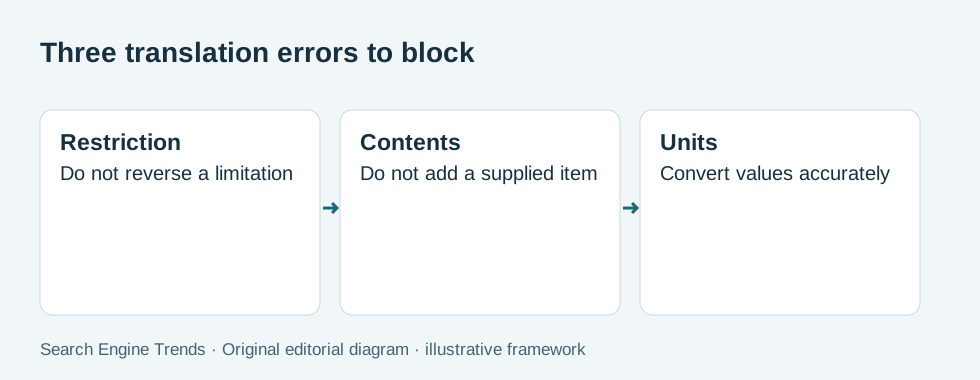
The lost restriction is a meaning reversal. The added battery is an unsupported promise. The unit change alters the product’s apparent dimensions. None is merely a stylistic issue, and replacing the wrong sentence with smoother wording does not resolve its factual error.
For dimensions, preserve the source unit or use a verified conversion clearly. Twelve inches equals 30.48 centimeters; it does not become twelve centimeters because a translation model substituted the unit label. If the displayed figure is rounded, use a rounding convention appropriate to the product information and retain the original evidence.
Use a glossary as one control, not the whole review
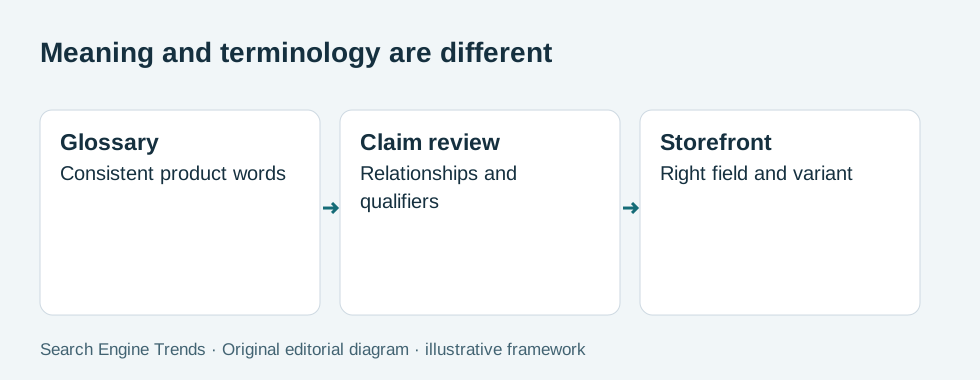
A glossary can standardize recurring product terms, parts and interface labels. Google Cloud describes terminology glossaries in its official glossary documentation. Check the requirements of the translation system actually used before applying a file; a spreadsheet labelled “glossary” does not prove the service consumes it.
Include an approved translation, context and owner for ambiguous terms. A word referring to a storage compartment may require a different translation when it names a mechanical part. Keep product identifiers and brand names intact where the actual naming policy requires it.
A glossary does not independently validate a whole sentence. The correct word for battery can still appear inside a false statement that the battery is included. The right term for outdoor can still appear after a lost negation. Review relationships, numbers and qualifiers as well as vocabulary.
Build a representative review batch
Choose records that include ordinary descriptions, excluded uses, multiple variants, supplied accessories and numeric units. Add at least one ambiguous source record to inspect whether the workflow flags the issue or invents an answer. Keep the sample’s limits visible instead of declaring a model reliable for the entire catalog.
Give each finding a consequence and action. A changed dimension blocks the affected buying claim. An awkward idiom needs language editing. A missing source qualification requires product clarification. This severity distinction helps the team prioritize without treating every spelling correction as equivalent to a misleading specification.
After correction, check the final storefront. Shopify’s localization documentation describes translated store content. Inspect product tables, variant labels, captions and confirmation messages as well as the main paragraph. A correct translation file can still be integrated into the wrong field or version.
Maintain the translation when the item changes
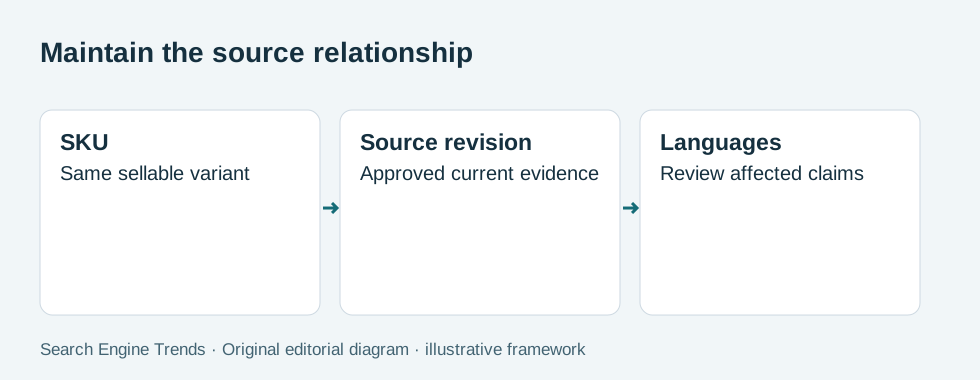
When a supplier updates a dimension or included part, identify the affected language versions through the shared SKU and source revision. Mark the translated claim as pending until reviewed. Do not assume an unchanged product title means the existing translation remains accurate.
Test a direct link to a translated variant and compare it with the source-language item. Check that both versions describe the same option, supported use and supplied contents. Language switching should not silently display another color or an old image that contradicts the updated record.
Meaning-first checklist
- Confirm exact product and source revision.
- Preserve negations and limitations.
- Check included and optional accessories.
- Recalculate any unit conversion.
- Review quantities, model references and variant names.
- Inspect the complete claim after glossary application.
- Check the final product page and related customer messages.
Keep a correction log containing the wrong claim, approved meaning and affected pages. That record helps the team update prompts and sources without pretending that a revised prompt eliminates the need for review. A practical translation workbook should preserve these decisions rather than promise error-free one-click localization.
Check the negative case beside the positive one
For the fictional outdoor-storage restriction, ask the reviewer to state both the permitted use and the excluded use in their own words. This reveals whether the sentence has preserved the boundary or merely retained a familiar product term. Compare headings and bullet points as well: an accurate restriction in the body can still conflict with a promotional subtitle.
For the battery, inspect the product image and contents table together. If the image shows a battery used for demonstration, label that context and preserve the sold-separately statement in the translation. Do not let the visual turn a correctly translated exclusion into an implied inclusion. These checks use ordinary buying evidence and prevent the review from focusing only on grammar while the purchase meaning changes.
FAQ
Does a fluent translation prove product accuracy?
No. Fluency concerns language. Product accuracy requires checking the translated meaning against the approved item-specific evidence.
Should all measurements change to local units?
Choose a clear display convention and verify conversions. Preserve the original value where useful, and avoid changing only the unit name while leaving the number unchanged.
What should happen when the English source is unclear?
Resolve or flag the source ambiguity first. A French translation should not turn an unresolved English attribute into a confident customer promise.
SEO Writing and Conversion
Explore this related DIY Marketing Guide guide to work further on the method. DIY is part of our business group; contents, language and price are shown on its store.
See the English guide