
Connect social content to sales pages by matching each product question with relevant evidence and a destination that continues the answer. For an agency serving Houston, plan the validation workflow, preserve campaign links and evaluate visits and purchases with their own definitions rather than claiming automatic sales impact.
In this article
- Give every post a reason to lead somewhere
- Choose three genuinely different questions
- Build a question-evidence-destination map
- Organise ten days around dependencies
- Track incoming campaign links consistently
- Keep visual evidence honest
- Read each destination according to its purpose
- Choose one next improvement from the evidence
Give every post a reason to lead somewhere
A social post and its destination should answer the same customer question. A general homepage link may suit an introduction, but a product-specific question usually needs a more precise page. Start with the question and evidence, then choose the route that helps the reader take the next useful step.
The scenario uses a fictional agency and bag retailer associated with Houston. No post has been distributed and no local campaign result is claimed. The ten-day plan is a preparation exercise, not a recommended city-specific posting frequency. Any commercial prices must come from the actual offer in USD.
The aim is not to force every publication into an immediate purchase. A dimensions question, a format comparison and a care question have different roles. Their destinations can support a decision without pretending each reader is ready to buy at the moment of the click.
Choose three genuinely different questions
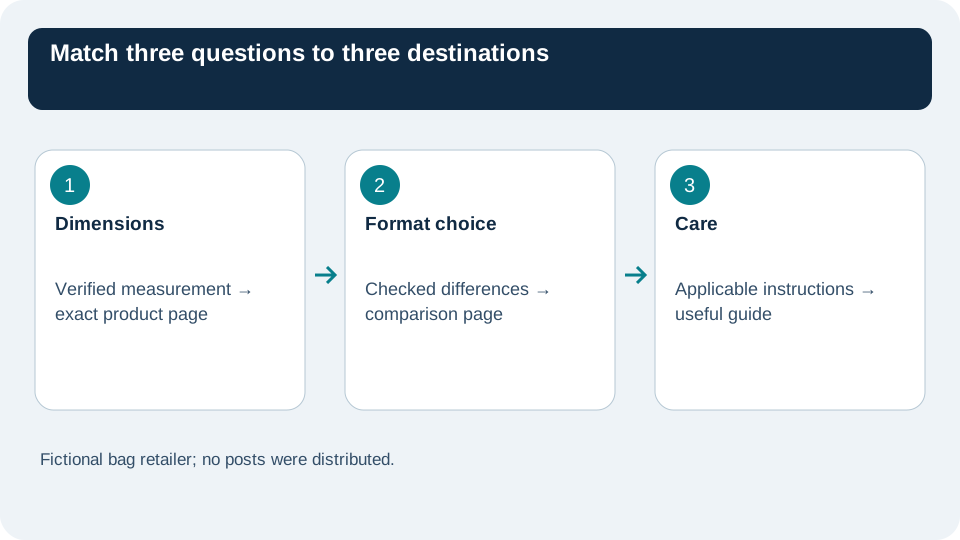
For a bag, the first question might ask whether its dimensions suit a particular use. The second compares a compact version with a larger model. The third asks how to care for the material. Each requires different proof: measured dimensions, an accurate comparison and applicable instructions.
Collect validated facts and authorised media before drafting. Confirm that the pictured model is the one currently sold and that accessories outside the offer are identified. Do not infer a capacity in litres from approximate outer dimensions or invent a care method because it looks plausible in a video.
Assign a destination to each question. A reference page should show the exact product. A comparison page should make the meaningful differences easy to find. A care guide should preserve the manufacturer's relevant conditions. Keep the next contextual link visible without making the reader search the whole website.
Build a question-evidence-destination map
The fictional content map below describes planned units rather than screenshots of real posts. The wording should announce what the linked page provides. A title that promises a comparison should not lead only to a product grid with no comparison criteria.
| Customer question | Proposed content | Evidence | Destination |
|---|---|---|---|
| Does this format fit? | View with dimension references | Validated measurements | Exact product page |
| Which size should I choose? | Two models shown together | Checked difference table | Useful comparison page |
| How should I care for it? | Explained care step | Applicable instructions | Care guide |
Open each destination on mobile. Check the answer, selected reference and route back to product details. The page should not show an older photograph or another variant simply because the URL looks similar. A correct caption cannot compensate for an incorrect destination.
Organise ten days around dependencies
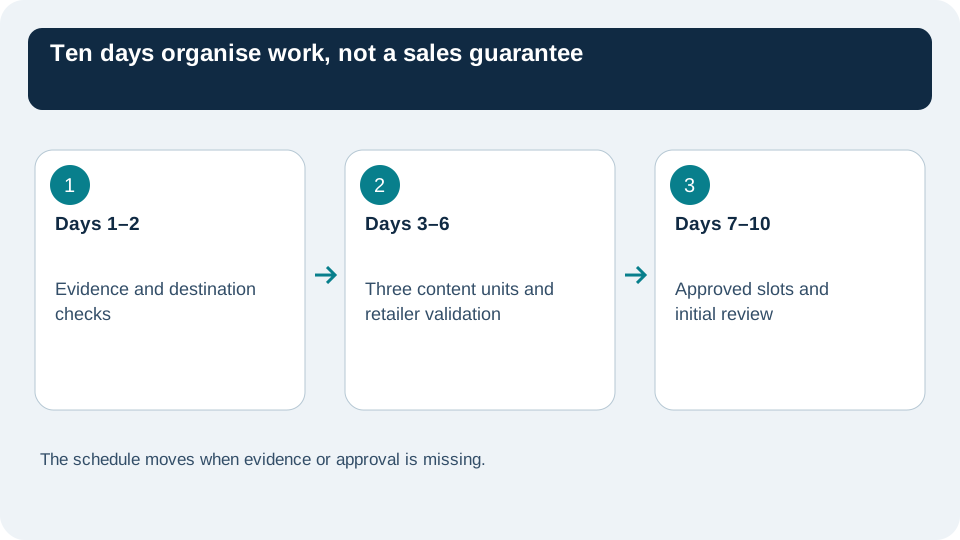
In the proposed exercise, days one and two gather evidence and check pages. Day three prepares the dimension content, day four the comparison and day five the care explanation. Day six is reserved for retailer validation. Days seven to nine are possible distribution slots only after approval. Day ten prepares an initial review.
These relative days are a workflow, not proof that ten days are sufficient to measure sales. Move the plan when a document or approval is missing. A publication deadline does not justify inventing a fact to finish a visual. Assign an owner and expected input to every step.
Allow time for revisions. A factual correction differs from a new product request or a change of channel. Keep the scope and decisions in a versioned brief so the agency and retailer can understand what was approved before any distribution occurs.
Track incoming campaign links consistently
Use a public naming convention for source, medium, campaign and content variant when your measurement supports it. Parameters describe the communication, not a customer. Do not put an email, customer identifier or order detail in a public URL.
Google Analytics documents custom campaign URLs. Check the parameters used by your actual measurement and keep a link register. Verify that redirects preserve the intended information. Do not add acquisition campaign tags to every internal transition between guide and product, where they could confuse the origin of the visit.
The link register should include the content unit, destination, public campaign names and validation date. If the product page changes, identify the active posts that refer to it. A content plan becomes harder to maintain when each URL exists only inside an unrecorded caption.
Keep visual evidence honest
A dimension diagram should identify what is measured and the unit. A comparison should use the same relevant criteria for both models. A care demonstration should show the procedure applicable to the sold material, with any necessary conditions preserved.
Avoid claims stronger than the evidence. Showing several objects inside a bag does not establish a guaranteed maximum load. A successful cleaning demonstration on one sample does not prove suitability for every version. Describe the scope and obtain the product owner's factual validation.
Check rights and version. A supplier image can represent an earlier component, while a client photograph may include another accessory. The team needs to confirm both permission to use the media and accuracy of what it depicts. These are related checks, but neither replaces the other.
Read each destination according to its purpose
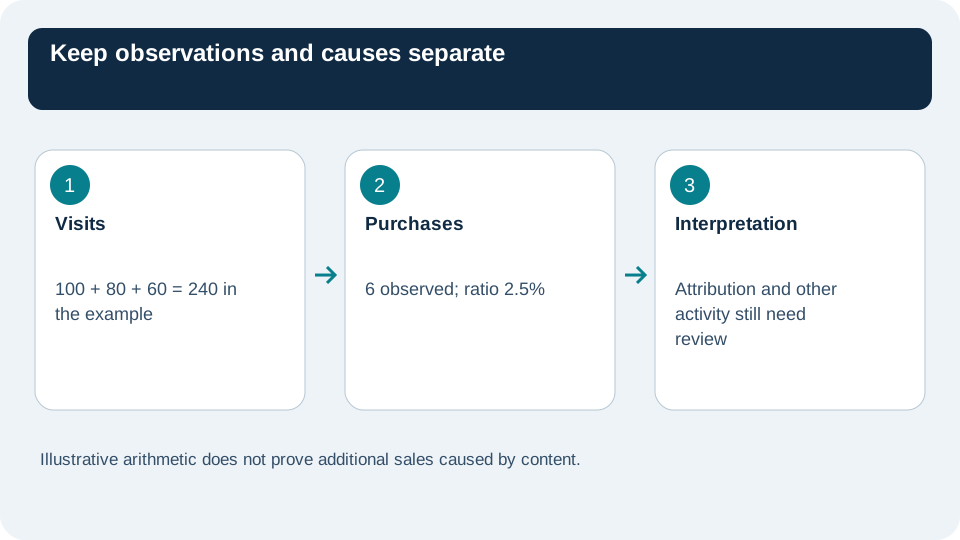
Suppose an invented scenario has one hundred identified visits to the product page, eighty to the comparison and sixty to the care guide. The relevant next action should be defined separately for each. A care guide may be useful when the reader finds an instruction, even if no immediate purchase follows.
Imagine six observed purchases after the 240 identified visits. Six divided by 240 is 2.5%. This does not show that the posts created six additional sales. Other campaigns, refunds and attribution limits need review before a causal statement or financial conclusion.
Keep platform clicks, site visits and confirmed purchases separate. A discrepancy calls for inspection of definitions, loading and collection, not replacement of the inconvenient number. Present the source and period of each observation so the report can be checked.
Choose one next improvement from the evidence
An inaccurate destination needs a page or link correction. An unclear comparison may need better criteria. A tracking gap needs a measurement check before interpreting the content as ineffective. The next action should match the problem that has actually been observed.
Begin with three questions for one product range and prepare the map, evidence and validation steps. Review the destinations before distribution, then read a bounded set of observations. The agency can explain the work performed and the customer journey it supports without claiming a Houston audience pattern or sales result that has never been measured.
SEO Writing and Conversion
Explore this related DIY Marketing Guide guide to work further on the method. DIY is part of our business group; contents, language and price are shown on its store.
See the English guide