
Start prospecting with a problem your service can solve and a clear definition of a suitable customer. Record observed needs, scope, decision-maker, timing and budget separately. A researched business becomes a qualified opportunity only after the relevant information is confirmed.

In this article
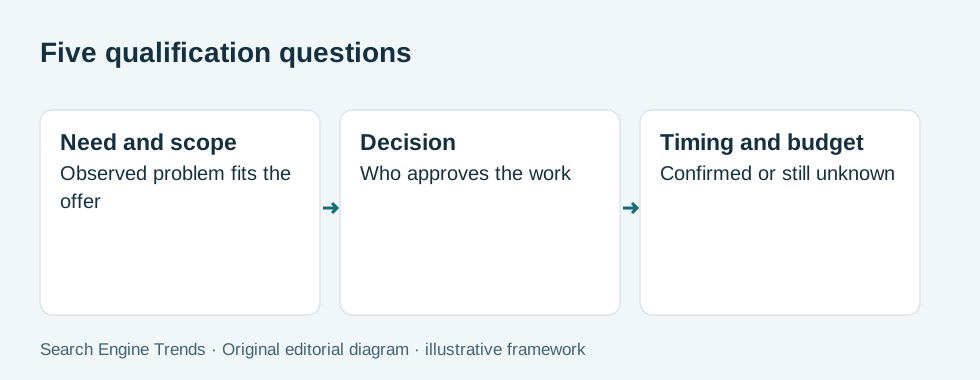
Build your first prospect list around a specific problem your service can solve. The hypothetical UK service example below shows how to separate research from a qualified sales enquiry. For an entrepreneur offering web improvements to shops, five useful criteria are the visible problem, fit with the service scope, decision-maker, timing and budget to confirm. Finding a business is the beginning of research, not evidence that it wants to buy.
This guide’s UK context is the illustrative GBP offer and the GOV.UK customer-acquisition resource. The qualification criteria do not describe an Oxford customer segment. Adapt the scope to your own service and check the requirements of the actual contact channel separately.
Define the small problem your offer solves
Choose a deliverable you can demonstrate and price. Updating a confusing product enquiry page is a clearer starting offer than “improving the internet presence” of every shop. State what the client receives, which information they provide and how both parties will know the work is complete.
For this hypothetical UK example, the entrepreneur offers a focused page review and a limited update. The service excludes a complete catalog migration and custom payment integration. Those exclusions help identify a suitable first project before the entrepreneur spends hours writing a proposal that cannot be delivered.
The GOV.UK guidance on attracting customers describes several channels for reaching new buyers. The worksheet below concerns preparation and qualification; it does not send messages or establish that a researched contact is eligible for every marketing channel.
Use five criteria without inventing answers
Record an observable need as a statement with evidence. “Opening hours differ between two public pages” is an observation. “The owner loses twenty sales a week” is an unsupported inference. Describe the problem you can see and leave its commercial impact for the relevant discussion.
Next, compare the need with your service boundary. A shop requesting a complete inventory connection is outside the focused page-update offer, even if its website also has a confusing contact button. Do not minimise the larger request just to make it fit the service you wish to sell.
Identify who can decide without assuming that the person answering a general inbox owns the budget. Keep timing and budget as unknown until confirmed. A useful record can contain unanswered fields; replacing them with optimistic guesses makes the prospect list less reliable.
Work through ten explicitly hypothetical cases
The following cases are invented and do not identify actual UK businesses. They illustrate qualification decisions, not local demand or response rates.
| Fictional case | Apparent need | Scope decision | Next useful step |
|---|---|---|---|
| A | Scattered opening hours | Focused page update | Confirm the actual need |
| B | Large catalog replacement | Outside current offer | Decline or refer |
| C | Confusing enquiry form | Targeted improvement | Identify the decision-maker |
| D | Announced new website | Unclear project | Request the scope |
| E | Missing product photographs | Media dependency | Confirm asset availability |
| F | No observed problem | Unknown | Avoid forcing a sales angle |
| G | Quote request received | Product-page work | Confirm timing |
| H | General marketing request | Unclear | Define the desired output |
| I | Complete redesign | Outside focused offer | Explain the limitation |
| J | Limited update | Potential fit | Confirm budget and access |
Three cases may deserve more information while two are clearly outside the offer. The exact count is an editorial consequence of this fictional table, not an expected sales funnel. Keep rejected cases with a reason so you can distinguish poor service fit from missing information.
Separate research, contact and a sales enquiry
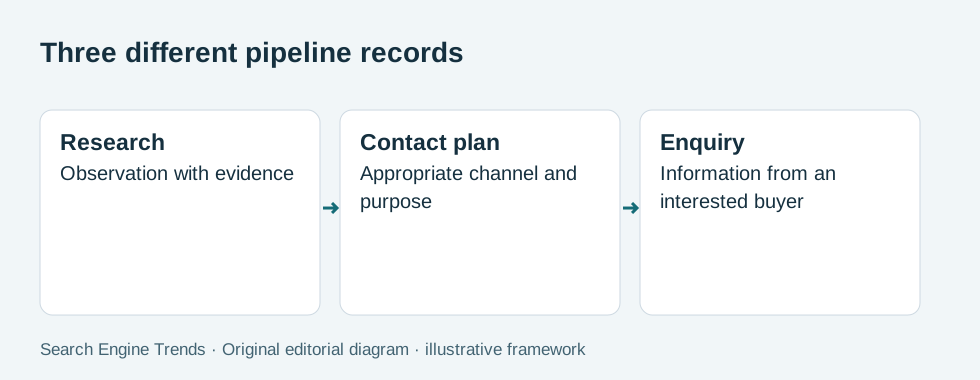
A research row stores the business and the observation. A contact plan identifies an appropriate channel and the purpose of the communication. A sales enquiry records information supplied by someone who is considering the service. Combining them can make a large uncontacted list look like an active pipeline.
If a shop has already submitted a quote request, respond to that request and ask the necessary scope questions. If you are considering outreach, review the actual channel requirements and your data-handling obligations before contacting anyone. Do not treat a publicly displayed email address as blanket permission for any campaign.
For a short qualification discussion, ask what the page needs to help a customer do, what assets and access are available, and who will approve the result. Then confirm the proposed output in plain language. A request for “better SEO” might mean more useful product information, a technical repair or a much larger acquisition project.
Move to a quote only when the scope is usable
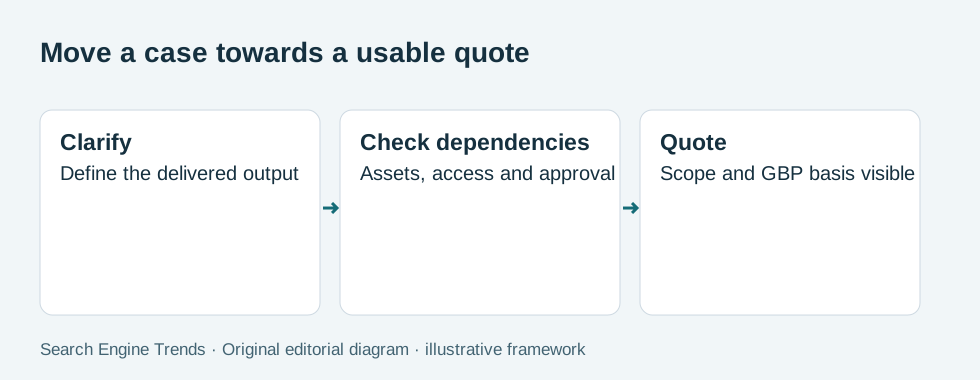
Prepare a quote when the deliverable, dependencies and decision process are sufficiently clear. Express the illustrative UK offer in GBP and separate optional work from the base service. Do not quote a fixed update price while assuming the client will quietly supply photography, translations or product evidence later.
Set a stopping rule for uncertain cases. If essential product facts are unavailable, offer a defined discovery step or pause the quote. If the requested outcome is outside your capability, explain the limit directly. A qualified pipeline should reduce uncertainty, not merely label every name as a promising lead.
Qualification checklist
- Keep the visible problem and its evidence together.
- Confirm that the request fits the service you can deliver.
- Identify the person who approves the work.
- Record timing and budget as confirmed or unknown.
- List access and media dependencies before quoting.
- Distinguish researched businesses from actual enquiries.
Review the list weekly by next action. A case waiting for a product brief needs a different action from one waiting for approval of a complete quote. Do not send the same reminder to both. This is where a small prospect workbook can help: it should show what to do next, not promise a certain number of clients.
Keep the reason for every stage change. A prospect moved to “ready for quote” should have the information needed to price the work, while a case moved to “not suitable” should identify the actual scope mismatch. This makes the list useful when the offer changes later.
FAQ
How many prospects should a new entrepreneur collect?
Start with a number you can research carefully and review. There is no universal list size that guarantees demand; a smaller set of relevant cases can teach more than a large unqualified directory.
Is an observed website issue proof of a sales opportunity?
No. The business may have another priority, an existing provider or no budget. Confirm the need and decision process before treating the case as a qualified opportunity.
What belongs in the first quote?
The output, included work, exclusions, dependencies, GBP price basis and acceptance process. Avoid turning an exploratory conversation into a proposal with invented requirements.

Find Your First Prospects
Explore this related DIY Marketing Guide guide to work further on the method. DIY is part of our business group; contents, language and price are shown on its store.
See the English guide